
RSS Marches Face Rejection In Tumakuru As Karnataka Approves Kalaburagi Rallies: Why Is RSS Not Registered Yet?
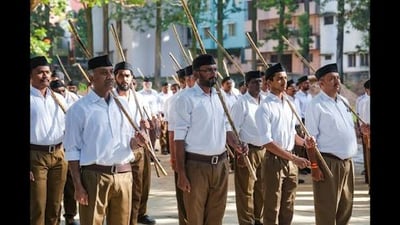
Police forces across Karnataka have taken two completely opposite paths regarding the annual Vijayadashami route marches planned by the Rashtriya Swayamsevak Sangh. While police in northern parts of the state gave permission under strict conditions, authorities in southern districts flatly refused to allow the public marches. This clear division in administrative decisions has brought forward critical public discussions regarding law enforcement, street safety, and whether private groups should be permitted to hold large uniformed marches on public roads.
In the northern city of Kalaburagi, local police approved the route march only after the organizers fulfilled specific state requirements. Deputy Commissioner of Police Shalu granted the conditional nod following the proper filing of Form 1 and Form 2, which are official applications required by the state home department. The march was permitted to move from Nagareshwar School to the Sharanabasaveshwara Jatra Grounds. Officials made it clear that organizers must follow the designated path, avoid provocative slogans, and ensure that regular commuters face no harassment.
Preparations also moved ahead in Hubballi, where massive gatherings were organized at Nehru Maidan with top political leaders scheduled to attend. High security measures were put in place across Hubballi and Mysuru to monitor large crowds and prevent any sudden disturbance to daily life. Even with police clearance in these areas, security personnel had to be stationed along every road corner to oversee the large movement of volunteers.
The situation was completely different in Tumakuru district, where senior police leadership rejected all requests for route marches. Organizers had sought permission to march through Tumakuru city, Tumakuru rural limits, and nearby towns including Kunigal and Gubbi, but every single plea was denied. District officials pointed to the active model code of conduct for the local graduates constituency election, noting that large gatherings could disturb law and order. The administration took the position that maintaining public peace and preventing community disruption was far more important than permitting private parades on busy thoroughfares.
The strict approach taken by some districts reflects the firm stance announced by Karnataka Home Minister Priyank Kharge. The minister openly declared that government officers and police forces do not work at the beck and call of any private organization. He stressed that merely sending an intimation letter to a police station does not give any organization the automatic right to block public roads. According to the state government, every organization must respect official administrative authority, submit required legal forms, and follow standard policing guidelines without expecting special treatment.
These route marches have faced growing criticism from common residents and civic observers. A route march is not an ordinary walk. It features hundreds of men marching in strict formation, wearing identical uniforms, beating heavy drums, and holding long wooden sticks while moving through busy marketplaces and crowded neighborhoods. For many everyday citizens, shopkeepers, and local families, such displays of street muscle feel intimidating rather than cultural. Critics argue that roads built with public tax money should belong to ordinary people for daily travel, not to private organizations seeking to showcase their physical strength.
Beyond the administrative debate over route permissions, a much bigger question continues to hang over the entire issue: why is the Rashtriya Swayamsevak Sangh still not registered under Indian law even after completing a full century of existence? This is an organization that holds immense power over Indian politics, shapes major national policies, and commands millions of followers. Yet, on official government records, it has never registered itself as a formal society, a company, or a trust.
Why has such a massive and powerful group avoided legal registration for an entire century? In India, ordinary citizens who want to start a small neighbourhood sports group, a charity kitchen, or a housing association must spend months filling forms under the Societies Registration Act or the Indian Trusts Act. They are legally forced to submit lists of members, reveal identity documents, declare office bearers, and follow state scrutiny. In sharp contrast, this massive socio-political body operates as an informal group without any central legal registration. It maintains no official membership register, gives out no formal membership cards, and keeps its core structure completely outside typical regulatory oversight.
This lack of formal registration creates serious questions regarding financial transparency. Every year, huge amounts of cash and voluntary funds are collected from volunteers during special rituals under the name of gurudakshina. Because the parent body is not registered as a typical public charity, it does not publish public balance sheets or submit its core accounts for public audit. Over the years, the organization has defended this by relying on the legal principle of mutuality, arguing that money collected by members for common internal goals cannot be treated as taxable income. Still, critical observers continue to ask how any group with such massive national sway can collect huge funds without providing the public audit trails expected of ordinary non-profit groups.
There is also the critical issue of legal responsibility on the ground. When an unregistered organization calls thousands of people onto public streets, who is legally accountable if violence occurs or public property is destroyed? In a legally registered trust or society, registered trustees and office bearers can be identified and held directly responsible before the courts. When an entity avoids formal legal registration, pinpointing legal liability becomes extremely complicated for police and courts.
Supporters argue that the movement was founded as a cultural brotherhood for character building rather than a corporate body, and that historical bans by past governments led the leadership to choose an informal structure to avoid political suppression. They also explain that separate affiliated trusts are registered under the law to handle buildings and charity programs.
However, in a constitutional democracy governed by the rule of law, massive power without formal accountability cannot escape public questioning. When small independent non-profits and rights organizations face intense government scrutiny, bank account freezes, and strict compliance checks, the continued lack of registration for the country's most powerful group raises serious questions. The contrasting police decisions in Kalaburagi, Hubballi, and Tumakuru show that state authorities are beginning to enforce basic paperwork. Yet, until the fundamental question of why the group remains unregistered is answered, these street marches will continue to provoke public debate.