
Russia UK Conflict Escalates over British Attack Drones Used Inside Russian Borders
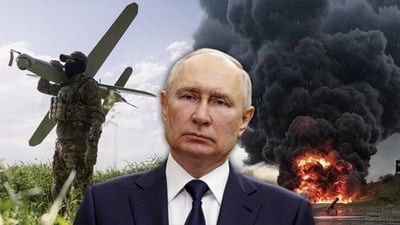
Tensions between Moscow and London have reached a fresh boiling point following public confirmation that Ukrainian forces utilized British-manufactured drones to carry out long-range strikes deep inside Russian territory. Officials from the Russian Embassy in London released a direct, sharply worded statement accusing the United Kingdom of intentionally expanding the boundary of the war. Kremlin diplomats claimed that British military assistance directly enables Kyiv to strike civilian and economic targets, warning that the deeper London embeds itself in the conflict, the higher the ultimate price it will pay.
The standard rhetoric from diplomatic channels quickly escalated as Russian Foreign Minister Sergei Lavrov declared that Moscow retains the absolute right to view direct British support as active involvement in the war. Reports confirmed that Ukrainian military units deployed specific British-designed autonomous aircraft, including jet-powered models, alongside domestic systems to hit supply chains, fuel facilities, and major distribution hubs located far beyond the front line. These long-range incursions have repeatedly rattled major Russian cities, bringing the reality of the ongoing war directly to the doorsteps of everyday citizens.
In response to the stern diplomatic warning, the United Kingdom Ministry of Defence remained firm, stating that British resolve against Russian aggression will not waver. British officials reaffirmed their total commitment to supplying Ukraine with the necessary defence systems required to protect its sovereign territory. The government emphasized that supporting Kyiv remains a foundational duty among Western allies and made it clear that military aid programmes, including long-term aerial defense and strike capabilities, will proceed unchanged despite Moscow’s furious warnings.
The underlying friction stems from a strategic shift in how the conflict is being fought. Over recent months, Ukrainian forces have relied heavily on sustained aerial strike campaigns targeting Russian energy infrastructure, manufacturing plants, and military logistical corridors. While Ukraine produces much of its own deep-strike capability locally, the integration of foreign-made technology provided by Western allies has vastly improved the range, flight stability, and precision of these air raids. For Moscow, the presence of British military equipment in strikes hundreds of miles inside its sovereign border represents a critical line crossed by Western nations.
Military analysts note that while Russia frequently issues public warnings over Western weapons shipments, the strategic calculations behind these diplomatic statements are clear. Moscow hopes to create public hesitation in Western capitals, aiming to weaken civilian support for multi-billion-pound military packages. However, military experts also highlight that covert hostility and intelligence friction between Britain and Russia have been taking place for years, spanning cyberspace operations, marine encounters, and aerial surveillance incidents across European air corridors.
As both nations double down on their positions, the regional security landscape grows increasingly unpredictable. Ukrainian leaders continue to argue that long-range strikes inside Russia are essential to weakening Moscow’s industrial capacity to wage war. Britain’s stance indicates that Western partners remain unwavering in supplying advanced hardware, leaving the conflict trapped in a escalating cycle of strategic long-range strikes and harsh diplomatic counter-measures.