
Sonam Wangchuk Vows To Continue Hunger Strike Beyond Sansad Chalo March And Lists Conditions To End Fast On July 20 2026
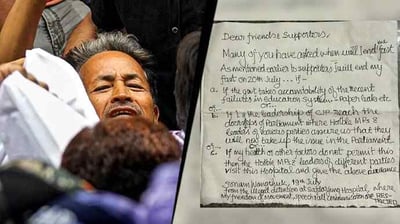
A frail 59 year old man lies on a hospital bed at Safdarjung Hospital in New Delhi, his body weakened after 23 consecutive days without food, yet his resolve remains unshaken. Sonam Wangchuk, the renowned engineer from Ladakh who once captured the imagination of the nation by building artificial glaciers, is now fighting a very different kind of battle in the heart of the national capital. On July 18 2026, Delhi Police forcibly removed him from his protest site at Jantar Mantar, citing medical concerns and court directions, and placed him under heavy security in the hospital. By July 19 2026, his weight had dropped by nearly 9 kilograms down to 57 kilograms, but his determination only grew stronger. From what he described as illegal detention with restricted movement and communication, Wangchuk released a handwritten message to his supporters, making it clear that his fast would not simply end with the planned march to Parliament. His words resonated deeply with thousands of young students across India who view his struggle as their own personal fight for justice.
The root of this massive agitation goes back to June 28 2026, when Wangchuk joined hands with the youth-led Cockroach Janta Party at Jantar Mantar to protest against widespread irregularities in competitive examinations, including the controversial NEET 2026 paper leak. For millions of hardworking students and parents who spend years of savings and endless sleepless nights preparing for entrance exams, paper leaks represent a crushing blow to their dreams and futures. Wangchuk turned his attention to this national crisis, demanding total institutional accountability, major systemic reforms in the examination body, and the immediate resignation of Union Education Minister Dharmendra Pradhan. The emotional intensity on the ground has been growing for weeks, turning a simple protest into a widespread public movement that brings human stories of frustration, anxiety, and hope directly to the forefront of national policy discussions.
In his emotional handwritten note shared ahead of the major mobilization on July 20 2026, Wangchuk clearly outlined 3 specific terms required to end his hunger strike. First, he stated he would break his fast if the central government officially takes accountability for the recent structural failures in the education system and examination leaks. Second, he offered to end the fast if he and the leadership of the movement are allowed to reach the doorsteps of Parliament where elected leaders and members of Parliament from various parties personally assure them that the issue will be formally raised in the house. Third, if his deteriorating health or security restrictions prevent him from moving, he requested that these political leaders visit his hospital room at Safdarjung Hospital to deliver that same solemn commitment. His wife, Gitanjali Angmo, reinforced this stance, appealing to political figures across party lines to step forward and address the genuine grievances of the nation while ensuring that all demonstrations remain completely peaceful.
As July 20 2026 arrived, the national capital witnessed high tension as Delhi Police deployed heavy security and imposed Section 163 orders across New Delhi district, explicitly refusing permission for the proposed Sansad Chalo march. Despite the strict police restrictions and warnings against unauthorized gatherings, thousands of passionate supporters and young citizens poured into Jantar Mantar to hold an overnight vigil and show solidarity with Wangchuk. Several prominent political figures, including Sanjay Singh, Shashi Tharoor, Dimple Yadav, and Chandrashekar Azad, visited the protest site or voiced support, while opposition leader Rahul Gandhi also broke his silence to address the situation. Simultaneously, Wangchuk’s wife approached the Delhi High Court requesting that her husband be allowed access to independent doctors or shifted to a private facility, though the court instructed full cooperation with government medical staff while calling for a status report by July 24 2026.
Looking closely at this unfolding crisis, one can see a profound friction between administrative security measures and the constitutional right to peaceful public grievance. The decision of the authorities to forcefully hospitalize a high-profile activist on the 21st day of his fast highlights the delicate boundary between protecting human life and suppressing visible democratic dissent. At the same time, Wangchuk’s seamless transition from demanding environmental safeguards in Ladakh to championing national educational integrity shows how deeply governance issues interconnect in modern India. Regardless of whether the marchers cross the security barricades toward Parliament or whether political assurances are delivered inside a hospital room, the fundamental demand for a transparent, leak-free education system has firmly established itself as a moral imperative that no administration can afford to ignore.