
Supreme Court Considers Petition To Shift Public Protests From Jantar Mantar To Alternative Venues
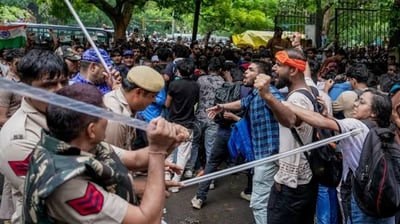
On August 3, 2026, the Supreme Court of India initiated a crucial legal proceeding that could fundamentally transform how public demonstrations and political gatherings take place in the national capital. A 3 judge bench led by Chief Justice of India Surya Kant, alongside Justice Joymalya Bagchi and Justice V Mohana, agreed to examine a public interest litigation challenging the continued use of Jantar Mantar as the primary venue for public protests in Central Delhi. Terming the petition as an important matter affecting public life, the apex court requested Solicitor General Tushar Mehta to seek instructions from the Union Government on whether a more suitable, secure, and spacious ground should be designated for mass assemblies. The judicial intervention comes at a time when frequent large scale gatherings in the heart of Delhi have raised mounting concerns regarding national security, severe traffic congestions, and severe disruptions to everyday civic life.
The public interest litigation, filed by petitioner Satish Chand Kaushik through advocate Aakarshan Aditya, contends that Jantar Mantar has outgrown its operational capacity as an official protest site. Decades ago, the narrow street near the historic observatory was earmarked for small, manageable, and localized demonstrations involving limited crowds. However, counsel argued that the rapid evolution of digital communication and social media mobilization allows modern movements to transform small gatherings into massive assemblies of several thousand people within a few hours. Because Jantar Mantar sits in extremely close proximity to Parliament House, the Central Vista administrative core, diplomatic enclaves, and commercial hubs, sudden mass gatherings create an unavoidable overlap between high security zones and unrestricted crowd movements, posing unpredictable law and order challenges for metropolitan authorities.
Beyond high security implications, the petition highlights the severe human cost borne by nearby residents, business owners, and daily commuters who navigate Central Delhi. Prolonged demonstrations frequently block major road arteries, causing endless traffic snarls that disrupt emergency medical services, impede public transport, and constrain daily mobility for thousands of ordinary citizens. The petition further emphasizes that the physical infrastructure surrounding Jantar Mantar lacks essential public amenities needed to support large crowds over extended periods. Protesters often face extreme difficulties regarding sanitation, clean drinking water, sewage disposal, and quick medical emergency exit routes. To resolve these systemic issues, the petitioner urged the court to direct authorities to discontinue Jantar Mantar as the default protest ground and designate larger, purpose built spaces such as Ramlila Maidan that possess broader perimeter security and superior logistics.
During the courtroom proceedings, the bench engaged in a thoughtful dialogue regarding the delicate constitutional balance between the fundamental right to protest and the rights of ordinary citizens to live without unreasonable disruption. Chief Justice Surya Kant observed that difficulties related to entry and exit routes, medical emergency access, and basic sanitation make the petition worthy of serious administrative consideration by central authorities. When the petitioner counsel brought up upcoming political demonstrations and warned against potential violent clashes similar to recent student agitations, the bench expressed full confidence in law enforcement capabilities, noting that administrative agencies possess the statutory authority to maintain order. The court reiterated that while democracy thrives on dissent, fundamental rights must co exist with mutual respect, ensuring that public expression does not permanently paralyze essential public functions or civic infrastructure.
This legal challenge touches upon a long standing constitutional debate over the regulation of public space in democratic governance. In previous landmark judgments, including rulings on protest sites in 2018 and the Shaheen Bagh case in 2020, the Supreme Court firmly established that the right to peaceful protest is an integral part of democratic expression, yet it cannot be exercised through indefinite occupation of public pathways. While the court previously lifted complete bans on demonstrations at historic sites, it consistently held that dissent must occur within properly designated areas that preserve order and public movement. As the national capital continues to witness dynamic political movements and mass mobilizations, the court current decision to seek a comprehensive response from the Centre marks a pivotal moment. The upcoming judicial review will determine whether Delhi administrative landscape will adopt modernized protest zones that protect democratic expression while safeguarding the daily lives of capital residents.