
Supreme Court Student Protest Violence Hearing Directs Relief For Protesters And Committee Protocol
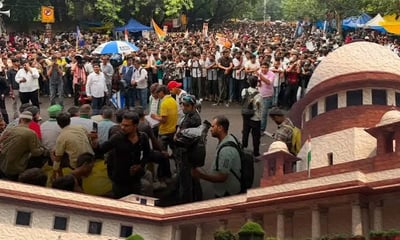
The highest court of the nation turned into a battleground of intense legal debate on August 3, 2026, as a 3 judge bench headed by Chief Justice of India Surya Kant alongside Justice Joymalya Bagchi and Justice V Mohana addressed the grave fallout of widespread student protest violence across India. The legal battle stems from nationwide demonstrations triggered by allegations of question paper leaks in national eligibility entrance tests. What began as a peaceful movement by thousands of young aspirants demanding transparency in competitive examinations escalated dramatically during the July 20, 2026 march toward Parliament in Delhi. Tensions boiled over as security personnel deployed heavy lathi charges, tear gas, and pellet guns to stop the crowds, resulting in serious injuries to numerous young demonstrators. At the same time, over 250 security officers were injured during the chaos. In response to multiple petitions filed by affected students, legal activists, and police representatives, the court stepped in to examine whether law enforcement overstepped its boundary or if violent elements hijacked a genuine student agitation.
Inside courtroom number 1, arguments raged over how young protesters were treated by law enforcement agencies following the clashes. Senior advocates representing the students brought troubling accounts to the bench, highlighting cases where students suffered permanent eye damage from pellet guns, severe injuries from nail embedded batons, and arbitrary detentions. Counsel pointed out that police forces in multiple states used advanced facial recognition technology and social media surveillance without explicit consent to identify, trace, and round up young participants. Further allegations emerged that police personnel in plain clothes assaulted protesters and that legal aid lawyers attempting to reach locked up students were themselves subjected to physical violence inside police stations. The court made it clear that while law enforcement officers must be protected while carrying out public duties, officers who resort to excessive force cannot hide behind official immunity. The bench questioned the legal standing and authorization behind using pellet guns on unarmed student crowds, stressing the urgent need to establish clear national protocols on permissible riot control measures.
Representing the central government, Solicitor General Tushar Mehta argued that the vast majority of genuine students would never engage in planned violence against law enforcement personnel. The government maintained that outside anti social elements and hardened individuals with ulterior motives infiltrated the peaceful crowds to turn the demonstration violent. Responding to concerns regarding widespread criminal cases registered against young citizens across states such as Delhi, Bihar, West Bengal, Assam, Uttar Pradesh, and Maharashtra, the government expressed a firm commitment toward resolving FIRs registered against non criminal students. The Supreme Court issued a major clarification, confirming that state governments possess the legal authority to close or quash FIRs against student protesters who have no prior criminal background. Furthermore, the court specifically defined criminal antecedents to mean only grave and heinous offences such as murder or rape, ensuring that petty driving violations or past peaceful political protest participation would not disqualify young students from legal relief.
The human dimension of this legal conflict stretches far beyond court transcripts and judicial declarations. For thousands of young aspirants across India, national entrance tests represent years of rigorous study, personal sacrifice, and family hopes. When allegations of paper leaks surfaced, these young individuals felt compelled to take to the streets to safeguard their academic future. The violent crackdown that followed left many young people recovering from physical trauma while facing the terrifying prospect of pending criminal charges that could destroy their future careers. On the other side, hundreds of lower ranking police personnel found themselves in hospital beds after being caught in violent clashes with mob elements. The courtroom exchanges underscored a painful dilemma where the constitutional right to peaceful protest came into direct conflict with public order management. By directing all state authorities to immediately release detained minors under the age of 18 and ordering the preservation of all CCTV footage, drone recordings, and body camera video from protest sites, the judicial intervention seeks to restore trust and accountability.
Looking ahead at the legal road, the Supreme Court indicated its intent to form a high powered committee headed by a retired senior judge to conduct an independent probe into all incidents of violence and police action across multiple states. The court emphasized that a scientific and evidence based investigation is necessary to distinguish between genuine student aspirants exercising their fundamental rights and agitators who used the protest to cause public destruction. By listing the next hearing for August 18, 2026, the bench gave states time to submit comprehensive status reports regarding FIR closures and evidence preservation. This landmark proceeding highlights the delicate balance between upholding law and order and protecting civil liberties. While the judicial process continues to unfold, the ruling offers a vital shield to young students against arbitrary police action while establishing a crucial legal precedent for how peaceful public protests should be protected in a democratic society.
This critical legal intervention serves as a defining moment for educational reform and public governance in India. The court recognized that prolonged legal battles and fear of prosecution can inflict irreparable harm on young minds whose primary focus should be education and personal growth. By restraining police from taking coercive steps against non criminal students and opening avenues for the withdrawal of charges, the judiciary has signaled a compassionate approach toward student agitators. At the same time, the insistence on strict accountability for police excesses alongside the protection of injured officers sets a balanced framework for governance. As the nation watches the upcoming proceedings, the outcomes from this Supreme Court hearing will shape not only the immediate future of the affected candidates but also the broader guidelines governing state power and citizen protest for years to come.