
Ukraine Drone Swarm Sets St Petersburg Oil Sites Ablaze Defying Washington Pressure Over Strikes On Russian Fuel Networks
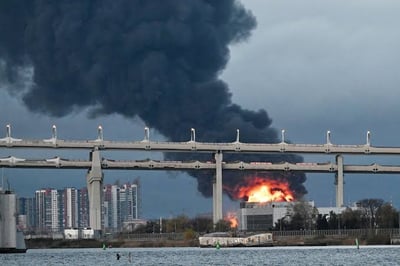
A dramatic escalation has unfolded across Eastern Europe as Ukrainian forces launched one of their largest aerial bombardments of the conflict, firing more than one thousand unmanned attack drones deep into Russian territory. The coordinated wave struck critical industrial and transport targets, sparking raging fires across vital energy facilities in the northern port city of St Petersburg. Thick black smoke billowed over the Gulf of Finland as emergency crews fought blazes at key petroleum terminals. Beyond the physical destruction on the ground, the massive operation highlights a widening diplomatic split between Kyiv and Washington, as Ukrainian military leaders openly push past Western warnings to cripple the economic fuel that powers the Kremlin war effort.
The strike carried deep symbolic and economic significance by hitting St Petersburg, the second-largest city in Russia and the historic hometown of Russian President Vladimir Putin. Local Governor Alexander Beglov confirmed that falling drones and explosive impacts ignited fierce fires at both the Petersburg Oil Terminal, a primary hub for maritime petroleum exports, and the city Ruchi fuel depot. Russian authorities reported that one person lost their life and five others sustained injuries during the attack. The barrage also disrupted local infrastructure, with drone impacts reported near a logistics warehouse belonging to internet retailer Ozon and a large data center run by technology company VK.
The Russian Ministry of Defense claimed that its air defense units and electronic warfare batteries detected and neutralized one thousand and fifteen Ukrainian drones across fifteen separate administrative regions, as well as over the Crimean peninsula and the Black Sea. However, the reality of burning fuel tanks in St Petersburg proved that enough drones penetrated multi-layered defensive shields to inflict serious damage. Kremlin spokesperson Dmitry Peskov addressed the incident, asserting to state media that Ukrainian forces were continuing active resistance but claimed such actions could not reverse the overall battlefield trajectory.
The military strikes unfold against a backdrop of diplomatic friction with the United States. United States President Donald Trump has publicly voiced strong criticism regarding Ukrainian attacks directed at Russian energy infrastructure, labeling refinery hits as counterproductive and expressing concern that such actions could drive global oil prices upward and complicate efforts to broker peace. The White House had previously announced an energy ceasefire proposal on the eleventh day of the month of October, suggesting that both combatants pause strikes against power grids and fuel reserves. However, that diplomatic announcement unraveled almost immediately on the ground.
Ukrainian President Volodymyr Zelenskyy defended the decision to resume strikes, asserting that Moscow never respected the proposed pause. Zelenskyy pointed out that Russian forces carried out seventy-six separate missile and drone strikes against Ukrainian power generation, oil, and gas installations in the week following the announcement. Overnight assaults in Ukraine knocked out electricity grids across four separate regions, plunging thousands of civilian households into darkness. Simultaneously, Russian strikes hit residential quarters in the southern city of Zaporizhzhia, killing a local woman, wounding a six-year-old child, and damaging apartment buildings and a school.
For the leadership in Kyiv, striking deep into the Russian energy machine is viewed as an essential survival strategy rather than a reckless provocation. Ukrainian strategic planners argue that crude oil and refined petroleum sales provide the primary revenue stream that allows Moscow to purchase foreign weapons, pay soldier salaries, and maintain its offensive operations. Ukrainian officials argue that asking a nation under daily bombardment to avoid striking the economic resources funding that bombardment is both unfair and strategically blind. By hitting oil terminals thousands of kilometers away from the front line, Ukraine seeks to force the Russian military to pull air defense batteries away from active battle lines to guard domestic facilities.
The widening distance between Kyiv and Washington poses serious strategic risks for the defense of Ukraine. While European partners have tried to step up defense aid, Ukraine remains heavily dependent on United States intelligence sharing, advanced satellite communication tools, and ammunition supplies. By openly defying the preferences of the American administration regarding oil targets, Ukrainian leaders are gambling that military necessity on the battlefield outweighs the immediate risk of diplomatic friction with Washington. Zelenskyy has repeatedly stated that treating the attacker and the defender as equal parties in diplomatic talks is a historic mistake, insisting that true peace can only emerge when heavy pressure is placed on the Russian economy.
The operation also demonstrated the growing scale and independence of the Ukrainian domestic drone manufacturing sector. Early in the conflict, Ukraine had to rely almost entirely on foreign-supplied precision weapons, which came with strict conditions barring their use on targets inside sovereign Russian territory. Over the past three years, Ukrainian engineers and private tech companies have designed long-range, propeller-driven drones capable of traveling over a thousand kilometers while carrying heavy explosive charges. Launching more than a thousand aircraft in a single operation reveals that domestic production lines have achieved industrial capacity, allowing Kyiv to conduct independent strategic strikes without seeking prior permission from Western allies.
The cross-border operation also caused unintended international alarms along the Baltic frontier. During the operation, an errant drone crossed into the airspace of neighboring Lithuania, prompting regional defense authorities to sound air raid sirens and order residents near the border to seek shelter. The aircraft eventually crashed in the northern Pasvalys district, damaging a passing civilian car but causing no human casualties. The Ukrainian Foreign Ministry promptly issued a formal apology to Lithuanian authorities, explaining that strong Russian electronic jamming systems had likely hijacked the navigation system of the drone and knocked it off its intended target path.
The towering flames at the St Petersburg oil sites reveal a conflict where the lines between the battlefield and home front have dissolved. Ukraine has signaled that it will not accept a diplomatic balance that leaves its own civilian electrical grid vulnerable while Russian oil terminals operate undisturbed. Even as Washington urges caution and warns against wider economic fallout, Kyiv appears determined to carry the war directly to the economic doorsteps of Russian industry, betting that only severe economic pain can bring an end to the fighting.