
US Religious Freedom Panel Urges Sanctions on RSS Members Over Mohan Bhagwat Visit to United States
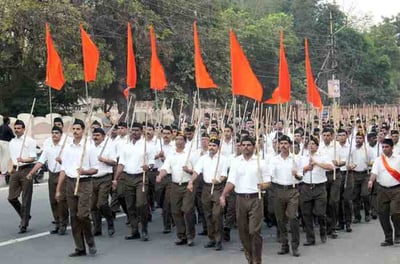
A major diplomatic controversy has erupted between Washington and New Delhi after an independent federal monitoring agency in the United States publicly called on the American government to impose targeted financial and travel sanctions on members of the Rashtriya Swayamsevak Sangh. The advisory body demanded that senior leaders of the influential Hindu nationalist organization be denied high-level diplomatic meetings, official receptions, or state courtesies during an upcoming international outreach tour. The unexpected policy recommendations have brought sharp scrutiny to bilateral relations, highlighting persistent friction over human rights monitoring and domestic political governance.
The public statements were formally issued by commissioners of the United States Commission on International Religious Freedom ahead of a scheduled overseas visit by organization chief Mohan Bhagwat. Under the planned itinerary covering North America and Europe, Bhagwat is set to participate in the Universal Oneness Celebrations organized by diaspora organizations in New York on 29 August 2026. The international tour marks part of extensive centenary outreach activities designed to engage overseas Indian communities, cultural associations, and prominent professional networks across the globe.
Commission Chair Asif Mahmood released a direct statement criticizing the planned visit, pointing out that Indian Prime Minister Narendra Modi is an active member of the organization. Mahmood described the body as a vast umbrella organization whose affiliated sub-groups have allegedly participated in targeted attacks against religious minority communities across India, specifically naming Christian and Muslim populations. In accompanying remarks, Commissioner Gene Mills stated that organizational leaders should not receive formal diplomatic recognition from American officials, urging the State Department to focus instead on enforcing statutory penalties against individuals accused of religious freedom violations.
The advisory body reiterated its long-standing recommendation that the United States Department of State formally designate India as a Country of Particular Concern under the International Religious Freedom Act. In past reporting periods, the commission has frequently advocated for targeted sanctions against specific state entities and intelligence apparatuses, suggesting travel bans and asset freezes over alleged civil rights concerns. However, the recommendations issued by the bipartisan advisory commission are non-binding on executive policymakers, and successive presidential administrations in Washington have consistently chosen not to adopt punitive designations against New Delhi.
The statements from the American panel have drawn strong pushback from Indian diplomatic representatives and international diaspora advocacy groups. The Ministry of External Affairs in New Delhi has historically rejected the commission's annual assessments as biased, selective, and motivated by narrow political agendas. Indian diplomatic officials maintain that the country remains a vibrant, pluralistic democracy with robust judicial safeguards that protect 1.4 billion citizens representing every major global faith, arguing that external bodies routinely ignore attacks and vandalism targeting Hindu temples and diaspora institutions located inside the United States.
Diaspora advocacy groups, including US-based organizations such as HinduPACT, also condemned the commission's public opposition to the community event, characterizing the move as an attempt to demonize peaceful cultural gatherings. Community leaders emphasized that the centenary celebrations in New York are aimed at promoting universal harmony, cultural dialogue, and social service initiatives among international diaspora chapters rather than advancing partisan political campaigns.
Foreign policy analysts observe that the recurring disputes between congressional advisory bodies and Indian institutions illustrate the delicate balance defining modern bilateral cooperation. While strategic, defense, and technological partnerships between Washington and New Delhi continue to deepen across the Indo-Pacific region, domestic political friction and differing viewpoints on religious freedom continue to generate public diplomatic disagreements.