
Why Indian Farmers Are Joining Hands With The Cockroach Janta Party Over The NEET Paper Leak Scandal
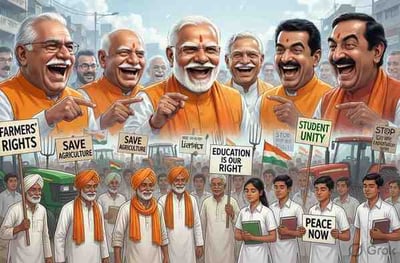
The central capital of India is witnessing a unique and powerful political convergence as the national examination crisis deepens. At the heart of New Delhi, a pressure group known as the Cockroach Janta Party has turned Jantar Mantar into an intense battleground for accountability. Led by its founder Abhijeet Dipke, this movement initially caught public attention through satirical digital campaigns but has now transformed into a full-scale overnight sit-in demonstration. The primary trigger for this massive public gathering is the controversial NEET-UG paper leak scandal, which has left millions of young medical aspirants feeling betrayed and helpless. Protesters have gathered in large numbers, carrying steel plates and spoons to make loud noises, an old symbolic method to wake up a sleeping administration. The core demands of this agitation are straightforward yet heavy. They want the immediate resignation of Union Education Minister Dharmendra Pradhan and a financial compensation of 10000000 rupees for the families of students who tragically ended their lives due to the stress caused by the compromised examination. On the 26th day of June 2026, which coincided with the birthday of the education minister, the atmosphere at the venue became highly symbolic as demonstrators wrote birthday messages on a large whiteboard requesting his resignation as the ultimate gift to the nation.
The movement has crossed a major threshold by successfully bridging the gap between urban student communities and rural agricultural laborers. In a strategic move to scale up the agitation, the organizers issued a direct appeal to the farming community of India. The logic behind this appeal is rooted in past solidarity, reminding the public that when Indian farmers were fighting on the borders of Delhi for their agricultural rights, the student community stood shoulder to shoulder with them. This call for reciprocal solidarity received an overwhelming response from the countryside. Prominent leadership bodies like the Samyukt Kisan Morcha and the Bharatiya Kisan Union have formally extended their full organizational backing to the agitating youth. Farmers from various states are traveling to the protest venue to show that the safety and future of the children of India is a collective national responsibility. This alliance completely changes the political dynamics of the agitation, turning a localized student grievance into a massive cross-sector civil rights campaign. The sight of elderly farmers sitting next to teenage medical aspirants under makeshift tents sends a strong message to the policy makers that the frustration with systemic corruption is no longer confined to educational institutions.
The operational reality on the ground highlights a severe friction between the state machinery and peaceful citizens. Delhi Police personnel deployed heavy security measures around the venue, placing multiple layers of barricades and utilizing advanced closed circuit cameras alongside body-worn equipment to monitor the crowd closely. Authorities attempted to dismantle the gathering by stating that the official permission for the demonstration expired at 5 pm on the opening Saturday. However, the demonstrators completely refused to leave the spot, converting the site into an overnight camp. Protesters face harsh conditions as basic municipal amenities have become scarce. Reports emerged that the water supply to the public restrooms at the site was disconnected for 2 consecutive days, causing severe inconvenience to the people staying overnight. Furthermore, volunteer groups who tried to distribute basic supplies like drinking water, lassi, and bananas to the crowd were allegedly stopped by security personnel who demanded their personal identity details and home addresses. This heavy-handed administrative approach reveals a deeper institutional anxiety. Instead of focusing resources on investigating the sophisticated networks that facilitate examination leaks, the administration appears to be channeling its energy into suppressing the voices that point out the structural vulnerabilities within the National Testing Agency.
The future of this joint mobilization is set to expand into a broader national challenge for the ruling administration. The pressure group has officially launched a countrywide campaign titled Pradhan Go Back, scheduled to hit its peak on Sunday, June 28, 2026. The movement is gaining crucial support from highly respected civil society figures, including the famous climate activist and educator Sonam Wangchuk, who has committed to joining the physical site and starting an indefinite hunger strike to demand accountability. This escalating situation shows that the core issue is no longer just about a single leaked test booklet. It has become a foundational debate regarding how a country treats its young demographic and preserves the integrity of its merit-based selection systems. When institutional loopholes allow affluent individuals to purchase question papers, it completely destroys the social ladder that allows hard working children from modest families to succeed. The combination of rural farming networks, civil rights activists, and a frustrated youth population creates a powerful coalition that the government cannot easily ignore. The outcome of this stand-off will likely determine not only the career paths of thousands of students but also the future standards of governance and administrative responsibility across the public examination framework of the nation.