
Ajnar River Clean Up Campaign Hit By Theft As Activist Bittu Tabahi Finds Dustbin Stolen Following Months Of Hard Work
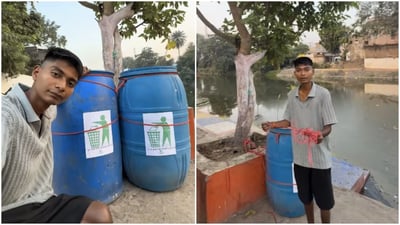
A young college student who captured hearts across the nation by dedicating his personal time and meager savings to revive a dying river has suffered a heartbreaking blow at the hands of unknown thieves. Surendra Singh Choudhary, an environmental activist known on social networks as Bittu Tabahi, returned to the banks of the Ajnar River in Madhya Pradesh only to discover that a large waste drum he had installed with his own money had vanished into thin air. The theft took place just a single day after the young man tied two large plastic dustbins to a riverside tree, attempting to convince local visitors and town residents to stop tossing polythene carry bags, plastic wrappers, and household garbage straight into the fresh flowing water.
The distressing discovery arrived right on the heels of another deep emotional disappointment for the young river protector. Having spent eight long months standing knee-deep inside filthy black mud and rancid muck to scoop out mounds of garbage with his bare hands, Surendra recently walked down to the bathing ghats only to see piles of trash accumulating all over the riverbanks once again. Realizing that his physical labor would count for nothing if daily human habits remained unchanged, he decided to take a positive, constructive step rather than giving up in anger. He bought two tall plastic storage containers, secured them firmly to a tree trunk with thick rope, and requested passersby to use the containers for their daily rubbish instead of turning the river into an open dumping ground.
When Surendra walked back to inspect the area the very next morning, disbelief and sorrow washed over him. The thick rope binding the containers had been sliced apart, and one of the two garbage drums was completely gone. Standing beside the single remaining barrel with mud on his rubber boots, the crestfallen student recorded a short video message to document the harsh reality of his situation. He expressed deep dismay that people would stoop to stealing a simple container installed for public welfare. He explained to his viewers that he had not put the drums there for his personal benefit or home use, but had provided them entirely as a community service so that the river waters could stay clean and breathable for everyone.
The story of how this young man took on the impossible challenge of cleaning an entire river began earlier in the year. While walking toward local neighborhood temples in the town of Biaora, located within the Rajgarh district of Madhya Pradesh, Surendra felt sickened by the state of the Ajnar River. What was once a pure, sparkling water stream that nurtured generations of farmers and supplied drinking water to local homes had transformed into a foul, black open drain. Heaps of discarded plastic bags, rotting vegetable remnants, torn garments, floating glass bottles, and chemical debris choked the riverbed, killing water life and creating an unbearable stench across the neighborhood.
Rather than waiting for municipal corporations, state departments, or local government contractors to take action, Surendra resolved to roll up his sleeves and clean the water body himself. Beginning on the twenty-sixth day of the month of January in the year 2026, he stepped straight into the contaminated waters. In the early days, a few local companions accompanied him, but as the grueling physical labor dragged on day after day under the burning sun, others fell away. Surendra persevered alone. Without high-tech excavators or motorized dredgers, he relied almost entirely on simple garden rakes, iron hooks, wire mesh nets, and his own physical strength, pulling out tonnes of decaying rubbish from the riverbed.
The clean-up mission demanded heavy personal sacrifices from the young science student. He spent nearly thirty thousand rupees from his modest savings to buy essential cleaning tools, safety gumboots, and sturdy waste bins. Because he spent hours submerged inside stagnant, dirty waters without proper chemical protection suits, the toxic water took a painful physical toll on his body. He suffered severe skin infections, peeling sores across his palms and feet, and chronic fungal rashes. When curious onlookers passed by, many mocked his single-minded dedication, laughing at him and sarcastically shouting that he was an uneducated boy who should go clean their household drains instead.
Despite the continuous ridicule and painful wounds, Surendra kept returning to the water every single day. Slowly but surely, the barren, black waterway began to transform. Fresh water began to sparkle in the daylight, river sand reappeared along the banks, and the natural flow of the Ajnar returned. Surendra shared videos documenting the before and after condition of the river on social media platforms, sparking an overwhelming national sensation. Famous industrialists like Anand Mahindra applauded his courage, the Chief Minister of Madhya Pradesh Mohan Yadav publicly praised his selflessness, and international ocean conservation organizations extended praise to the twenty-year-old youth for demonstrating what individual civic courage can accomplish.
Yet, as the stolen dustbin painfully proves, cleaning up physical garbage is far easier than changing centuries of careless civic behavior. Across many towns and villages, thousands of citizens still believe that flowing water acts like an invisible disposal bin that washes away filth without consequence. People continue to throw religious offerings inside plastic wrapping, toss snack packets from vehicle windows, and dump house sweepings over bridge railings. Even when clean bins are provided, a chronic lack of civic responsibility leads individuals to either ignore the facility or, worse, steal public property for selfish private benefit.
The news of the stolen dustbin has triggered an outpouring of sympathy and anger across the nation. Social media users expressed profound sorrow for Surendra, pointing out that his relentless positive energy is being crushed by widespread community apathy. Commentators and civic activists called on local municipal officials and police authorities to take immediate notice of the incident, demanding that security cameras be installed along the riverbank and heavy financial penalties be slapped on anyone caught littering or damaging community infrastructure. Many citizens noted that while governments often spend hundreds of crores on river rejuvenation advertisements, they fail to provide even basic security protection to young, genuine grassroots heroes working on ground reality.
Surendra has already proven that his vision reaches far beyond the boundaries of his hometown. In recent months, he expanded his cleaning mission to the national capital region, gathering volunteers to clear thousands of kilograms of trash from the banks of the sacred Yamuna River in Delhi, followed by community drives in nearby suburban industrial cities like Gurugram and Noida. His motto of collective environmental action has inspired countless young college students to reconsider how they treat local water resources.
The sad incident at the Ajnar riverbank serves as an urgent wake-up call for society as a whole. A clean environment cannot depend entirely on the lonely shoulders of a single determined twenty-year-old boy. Until everyday citizens learn to treat public resources with respect, take pride in keeping shared spaces tidy, and protect community assets from theft and vandalism, the water bodies that sustain human life will remain in grave danger. Surendra Singh Choudhary has shown the nation how to care for a river; it is now up to the community to prove that it is worthy of his selfless work.