
Nepal Tibet Flash Flood Kills 804 with 3000 Missing as US Grand Canyon Floods Leave 15 Lost
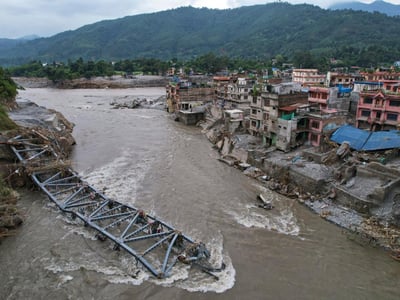
Rescue teams across two continents are confronting scenes of unimaginable devastation as violent flash floods tear through remote mountain valleys and desert gorges. Across the border region connecting northern Nepal and Tibet, entire settlements were obliterated within minutes when a massive surge of water, rock, and mud tore down river channels. At the same time, emergency teams in the United States are carrying out high-stakes search and rescue operations deep inside the Grand Canyon after sudden torrential weather trapped dozens of hikers and washed away essential crossings.
The scale of human suffering in the Himalayas is immense. Confirmed fatalities have climbed to 804 across the region, with Nepal recording 788 deaths and the Tibet region of China reporting 16 deaths. More than 3048 individuals remain unaccounted for, including hundreds of foreign nationals and over 900 infrastructure workers. In riverside towns across Rasuwa, Nuwakot, and Dhading districts, survivors describe a wall of liquid concrete that gave no warning. Families have gathered outside emergency hospital wards in Kathmandu, clutching photographs of loved ones, while authorities take DNA samples from recovered victims before conducting burials to allow future identification.
The tragedy began on the morning of 26 August 2026 at 8:37 AM local time. High along the Himalayan ridge at an elevation of 5200 meters in Gyirong County, a massive 0.2 square kilometer slab of glacial ice and rock broke away from the mountain face. Plunging 1.2 kilometers vertically, the impact registered as a magnitude 5.2 seismic event. The energy melted ice instantly and gathered loose mountain sediment, unleashing a violent hyperconcentrated debris torrent. The deluge swept through the Lhende Khola and Bhotekoshi river basins into the Trishuli River, where water levels surged by 9 meters within 30 minutes, sweeping away customs posts, residential settlements, and major highway bridges.
Across the globe on 29 August 2026 at 2:30 PM, another sudden hydrological catastrophe unfolded in the United States. An intense convective cloudburst struck the North Rim of Grand Canyon National Park in Arizona, dumping up to 2.5 centimeters of rain in under half an hour. The desert terrain, characterized by sun-baked rock and steep vertical drops of 1800 meters toward the Colorado River, could not absorb the downpour. A four-foot wall of muddy water rushed through Bright Angel Canyon, destroying nearly all suspension footbridges across Bright Angel Creek. While emergency crews and the Arizona Department of Public Safety airlifted 62 people from Phantom Ranch, at least 15 to 20 hikers and campers remain missing in the inner canyon.
These dual catastrophes highlight a critical question confronting modern society: are these disasters purely unavoidable natural hazards, or are they human-made crises? While rainstorms and rockfalls are natural physical events, their transformation into mass-casualty catastrophes is largely driven by human decisions. Atmospheric warming is degrading high-altitude permafrost, the frozen thermal binder that has held alpine rock walls and glaciers stable for millennia. When that frozen ground thaws, mountains lose their structural integrity. In lower desert gorges, hotter air masses hold significantly more moisture, triggering hyper-localized downpours that drop massive volumes of water onto impermeable rock surfaces.
The deeper crisis lies in the way modern economic systems expand directly into dangerous natural pathways. In river corridors like the Trishuli, extensive investments in run-of-the-river hydroelectric projects, road widening, and commercial border infrastructure have placed thousands of laborers and concrete installations directly on historical floodplains. When the glacial collapse occurred, it was not merely an uninhabited mountain that moved; it was a heavily populated commercial zone that was submerged. At the Trishuli 3A hydroelectric site alone, more than 100 workers were trapped inside a flooded tunnel, forcing soldiers to drill emergency air pipes through rock to keep them alive while rescue excavators dig through debris.
Traditional economic planning consistently measures success through gross domestic product, energy output, and tourism revenue, while treating environmental stability as an external factor with zero financial value. Building massive dams, transport corridors, and canyon tourist centers boosts short-term national accounts. However, this narrow focus ignores the economic value of intact glaciers, natural river buffers, and healthy forests. When low-frequency, high-severity weather events strike, the entire capital base is destroyed, wiping out billions of dollars in infrastructure along with human lives.
This pattern demonstrates the failure to integrate environmental economics into development policy. In conventional project appraisal, the profits from energy and tourism are privatized by operating companies, while the catastrophic liabilities of rescue operations, body retrieval, and community reconstruction fall onto public budgets and vulnerable local populations. Furthermore, countries like Nepal produce only 0.1 percent of global greenhouse gas emissions yet bear the brunt of climate-induced mountain degradation, breaking the fundamental economic principle that polluters must pay for the damage they create.
Disaster mitigation experts emphasize that continuing to prioritize rapid commercial growth without respecting ecological limits ensures that future weather events will yield even higher casualties. If governments, developers, and global institutions do not implement genuine natural capital accounting, halt reckless construction across active floodways, and build advanced early warning networks, economic development will continue to turn natural occurrences into human tragedies.