
Albania Parliament Attacked With Petrol Bombs As Violent Street Protests Shake Capital City Tirana
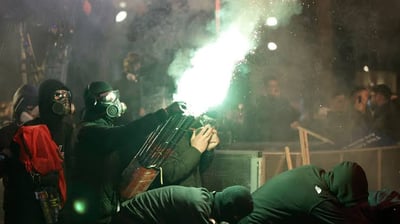
Flames, dense smoke, and shattering glass took over the main streets of Tirana as intense anti-government demonstrations spiraled into widespread violence across the capital of Albania. Angry crowds marched toward key state buildings, hurling handmade firebombs directly at the national parliament and leaving public structures burning in the dark. What began days earlier as a peaceful call for fair education standards has erupted into an open street battle between citizens and security forces. Across central boulevards, riot police formed heavy defensive lines, using tear gas and strong jets of water from armored trucks to push back waves of young demonstrators who refused to clear the roads.
The visual scenes captured on the ground showed the terrifying scale of the destruction. Outside the presidency building of the parliament, flames rose into the night air after protesters managed to force their way into the premises and light fires inside. Several vehicles, including cars and police motorcycles parked near the city famous cultural monuments, were flipped over and torched. At another intersection, demonstrator squads hurled glass bottles filled with gasoline toward the entrance of the Interior Ministry and set a neighborhood police station on fire. Nearby government offices, including the Education Ministry and parts of the Supreme Court complex, suffered broken windows, blackened stone walls, and charred entry gates.
Behind the violent chaos lies years of deep human pain, poverty, and everyday struggle. For ordinary Albanian families, making ends meet has become an almost impossible challenge. Basic food items, medicines, and electricity bills have climbed far beyond what a normal household earns each month. Young people finishing high school and university discover that well paying jobs are almost nonexistent unless someone has personal ties to powerful politicians. Thousands of educated young Albanians pack their bags every single year to search for work in distant European countries, leaving elderly parents behind in empty towns. Those who remain feel trapped in an economic system that offers little hope for a comfortable future.
The anger first boiled over inside university lecture halls, where students grew tired of paying heavy tuition fees while studying in broken classrooms without proper heating or books. Young scholars formed loose student groups, carrying signs that demanded an immediate end to high education fees and better student dormitories. However, the student rallies soon merged with wider public anger over a controversial luxury seaside tourism project that the government approved on the Albanian coast. The commercial development, linked to family members of American political figures, sparked fierce outrage among locals who accused top ministers of handing over protected national beaches to foreign rich investors while ignoring the poverty of local fishermen and villagers.
As the days went on, political opposition leaders and ordinary working citizens joined the student marchers, turning the demonstrations into an overwhelming national movement. The crowds gathered under banners demanding the complete resignation of Prime Minister Edi Rama, who has governed the country since 2013 and recently secured a fourth term in office. Critics accuse his government of allowing corruption to hollow out state institutions, rigging political contests, and using the police to harass dissenting voices. For many in the crowd, throwing stones and firebombs was a desperate attempt to break through the wall of official silence and force the political class to listen to their demands.
The human toll of the street battles has grown heavier with each passing day. By Sunday, October 18, 2026, hospital records showed that roughly three hundred individuals had suffered serious injuries during the clashes across Tirana. Emergency rooms treated dozens of young protesters for head injuries, broken bones, and severe breathing problems caused by chemical tear gas. On the other side of the barricades, more than one hundred police officers were injured by flying rocks, metal bars, and firebombs, with several suffering painful burns. Police squads carried out sweeping crackdowns across several city sectors, detaining dozens of young people and launching criminal investigations against dozens more on charges of violent destruction and public rioting.
Despite the burning buildings and rising casualty numbers, Prime Minister Edi Rama came out swinging, firmly rejecting any possibility of stepping down from his post. Addressing police officers during a visit to security units, Rama praised the force for defending the state and announced special cash bonuses and salary increases for officers serving on the front lines. He argued that burning government property and attacking parliament crossed a clear red line that no civilized democracy could tolerate. Rama claimed that the violent unrest was not a true public movement but a coordinated effort by political rivals and foreign adversaries seeking to derail Albania long held ambition of joining the European Union.
The tough response from the head of government has only widened the division between the state and its citizens. A large collective of university professors broke their silence, issuing an open joint letter that strongly condemned police violence against young students. The teachers demanded an immediate halt to nighttime arrests, called on the Prime Minister to resign, and suggested the creation of a temporary caretaker government to restore public trust and prepare the ground for fresh elections. Meanwhile, local business owners in central Tirana spent daylight hours sweeping broken glass from shop floors, fearful that another night of violence would wipe out their livelihoods entirely.
The spiraling crisis in the small Balkan nation has triggered urgent alarm across international capitals. Officials from the European Commission in Brussels issued a statement urging all parties to abandon street violence and resolve their political disagreements through calm, democratic talks. In Tirana, the United States embassy released a public message urging both the government and protest leaders to exercise maximum restraint, warning that burning down public buildings harms the democratic standing of the entire country. International partners worry that if the unrest continues to spread, it could destabilize the wider region and shatter hopes for regional stability.
For regular citizens watching their hometown burn, the feeling of sadness is overwhelming. Many older residents who lived through difficult political transitions in decades past say they never wished to see petrol bombs flying across the parliament gates again. At the same time, mothers and fathers walking with the students insist that peaceful appeals had been ignored for far too long, leaving young people feeling that nobody cared about their future. The battle on the streets of Tirana has laid bare a broken connection between an entrenched political leadership and a desperate younger generation that feels it has nothing left to lose.
As night falls once again over Tirana, a tense silence hangs across the scorched avenues. Barricades still lie charred on the asphalt, broken concrete pieces cover the sidewalks, and the smell of smoke lingers in the autumn air. Fire crews continue to monitor cooling buildings, while lines of heavily armed security officers stand watch outside the blackened gates of parliament. With neither the determined protesters nor the government showing any willingness to compromise, the people of Albania remain braced for another round in a struggle that is reshaping the nation future before the eyes of the world.