
Manipur Kamjong Violence Leaves One Dead And Fifteen Houses Burned As Gun Attack Forces Villagers To Flee Has Modi Government Failed To Protect North East And Manipur ?
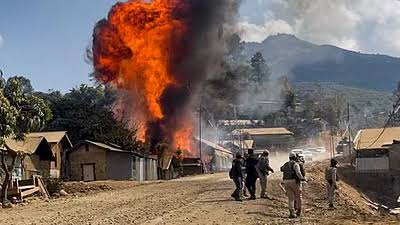
Fresh violence has shaken the northeastern border state of Manipur as armed attackers targeted quiet hill settlements in Kamjong district, setting fire to at least fifteen family houses and opening fire on local residents. The sudden night attacks turned peaceful wooden homesteads into towering walls of flame, forcing helpless men, women, and young children to run into the dark wilderness to save their lives. A local civilian lost his life in the gunfire, while several others suffered serious bullet injuries during multiple shootouts across the district. The terrifying series of events has broken a brief period of calm in the border belt, bringing panic back to communities that have spent years living under the shadow of ethnic conflict.
The worst devastation occurred in the peaceful hill hamlet of Chassad, located close to the international border with Myanmar. Heavily armed militants slipped into the village late at night, catching families completely off guard as they slept inside their homes. The attackers set fire to residential properties one by one, watching as flames consumed thatched roofs, food grain stores, and personal belongings. Flashing orange skies and thick smoke signaled danger across the valley, forcing terrified villagers to grab their small children and scramble into nearby thick forests or run toward an Assam Rifles security base for basic shelter and physical protection.
The late-night arson attack followed a deadly shooting that had broken out in the very same village earlier during the daytime. Suspected armed fighters had entered the rural settlement and sprayed bullets at unarmed local people without warning. A civilian identified as Seikhaohao Haokip was struck by gunfire and died from his wounds, while four other villagers sustained painful bullet injuries. Village elders who rushed to help the victims found themselves trapped in crossfire before emergency medical help could reach the remote hill path. The daytime killing had already created deep shock, but the late-night burning of fifteen family dwellings proved that the attackers intended to wipe out the entire settlement.
The terror was not limited to Chassad village alone, as armed clashes spilled into the main administrative headquarters of Kamjong district during the very same night. Gunfire echoed through the streets as rival armed groups clashed, firing automatic weapons across open roads. During the chaotic shooting, three local Tangkhul Naga civilians, identified as T. Chithung, S. Malung, and M. Shithung, were caught in the line of fire and suffered bullet injuries. Local emergency volunteers quickly moved the wounded men to the Kamjong district hospital, where medical staff worked under emergency conditions to stabilize their bleeding wounds and keep them out of critical danger.
The sudden flare-up along the border has sparked sharp political reactions inside the state administration. Manipur Deputy Chief Minister Nemcha Kipgen came forward to strongly condemn the bloodshed, describing the torching of innocent family homes as an intolerable and cruel crime against humanity. She expressed deep personal grief over the death of the village resident and voiced deep worry for the injured leaders and displaced families who lost everything they owned in the fire. Kipgen instructed top district police officers and central armed units to stay on maximum alert twenty-four hours a day, protect local populations from further aggression, and make sure that the criminals responsible for the arson and killings are tracked down and punished through the legal system.
To prevent the violence from spreading into neighboring hill villages, senior authorities ordered a massive deployment of armed security personnel across the sensitive border belt. Heavy columns comprising the Assam Rifles, the Border Security Force, and the state police force moved into Chassad and the district headquarters to set up checkpoints, secure main village roads, and conduct search operations along jungle boundaries. At the same time, the state government took administrative action by transferring the Superintendent of Police of Kamjong district with immediate effect, reflecting official displeasure over security lapses that allowed armed groups to enter residential areas undetected.
The latest wave of destruction has reopened deep questions across the country over whether the central government led by Prime Minister Narendra Modi has failed to protect the North East and Manipur. Opposition leaders, civil rights organizations, and local community representatives point to clear facts on the ground as proof of a breakdown in state protection. More than two hundred people have lost their lives, over sixty thousand citizens remain displaced in relief camps, and thousands of sophisticated automatic weapons looted from state police armories still remain unrecovered in the hands of rival armed groups. Critics argue that despite heavy deployments of central paramilitary troops, basic civilian life and private property continue to be destroyed without consequence.
Community councils have expressed extreme frustration over the prolonged political deadlock. Tribal leaders emphasize that despite years of unrest, Prime Minister Modi has not visited the state to meet displaced families, hear grassroots grievances, or lead a direct peace dialogue between conflicting groups. Both hill tribes and valley residents feel neglected by New Delhi, noting that high-level administrative promises have failed to stop sudden ambushes, night arson, and highway extortion. The fact that armed mobs can still enter villages, shoot civilians, and burn down fifteen houses in a single night serves as undeniable proof that administrative control remains dangerously weak in the region.
Life for ordinary families in the hill areas has become a daily struggle for basic physical survival. Parents who spent their entire lives farming small terraced fields and raising livestock now find themselves living in crowded community halls or under plastic sheets inside muddy forests, wondering how they will feed their children tomorrow. The destruction of fifteen homes means that years of simple family savings, school books, warm winter clothing, and ancestral land papers have turned into gray ash. Local teachers and community elders note that children are deeply traumatized by the sound of gunfire and the sight of burning neighborhood huts, leaving mental wounds that will take years to heal.
The geographic location of Kamjong district adds another layer of complexity to the security situation. Sharing a long and porous international boundary with Myanmar, the mountainous terrain features dense forests, deep river valleys, and isolated dirt roads that make round-the-clock patrolling challenging for security forces. Armed groups often take advantage of these difficult wilderness tracks to move weapons, carry out hit-and-run attacks against rival settlements, and quickly escape into thick jungle canopies before central security columns can respond. Tightening border movement and keeping open communication with village heads remain vital if future surprise strikes are to be stopped in advance.
The tragic events in Kamjong serve as a painful reminder that genuine peace remains elusive in Manipur as long as illegal weapons remain in circulation and community fear continues to dictate daily life. Burning down family homes and taking innocent lives will never resolve historical grievances or bring security to any single ethnic community. Only honest dialogue, strict disarmament of armed gangs, and swift state justice for victims can give ordinary villagers the confidence to leave the cold forest camps, walk back to their ancestral lands, and rebuild their shattered lives in lasting peace.