
Assam Flood Death Count Rises To 100 As Over 1 Lakh People Face Severe Deluge
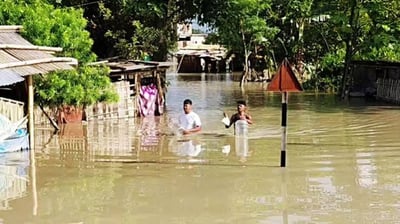
The severe deluge in Assam has reached a devastating milestone as the loss of life reached one hundred following fresh drowning casualties reported in Golaghat and Karbi Anglong districts. Across the eastern state, over one lakh thirty thousand residents continue to endure intense hardship as persistent waterlogging inundates residential areas, farmlands, and vital infrastructure. Official daily reports from the Assam State Disaster Management Authority confirm that floodwaters have submerged hundreds of villages across multiple districts, including Golaghat, Sivasagar, Hojai, Darrang, Lakhimpur, Jorhat, Karbi Anglong, Charaideo, Nagaon, and Biswanath. Golaghat remains the most severely hit territory, where nearly seventy thousand individuals are grappling with submerged homes and disrupted livelihoods. Sivasagar follows closely as the second worst-hit district with around forty thousand affected citizens, while Jorhat has recorded over sixteen thousand residents struggling against rising river levels. The relentless swelling of major rivers has turned expansive rural stretches into massive sheets of water, forcing families to flee their inundated homes in search of higher ground along embankments and national highways.
The humanitarian impact on the ground has escalated as major river systems continue to flow well above their designated danger marks. Key rivers such as the Dhansiri at Golaghat and Numaligarh, along with the Kushiyara at Sribhumi, are overflowing their banks, posing an ongoing threat to downstream settlements and agricultural fields. District authorities in Golaghat have issued urgent public advisories instructing residents to stay clear of riverbanks as water levels maintain a steady upward trajectory. Across inundated districts, floodwaters have swallowed over eleven thousand hectares of standing crops, dealing a severe economic blow to farming communities who depend heavily on seasonal harvests for survival. In addition to agricultural losses, domestic livestock and poultry have been severely impacted, with tens of thousands of animals stranded without adequate fodder or dry shelter. The destruction of rural road networks, submerged bridges, and damaged embankments has severely restricted vehicular movement, making it extremely challenging for local communities to access essential supplies or medical assistance without external aid.
To shelter the growing number of displaced families, state authorities have set up dozens of relief camps and distribution centers across the worst-affected districts. Over forty-nine thousand displaced individuals are currently seeking shelter in these designated centers, where local administration teams are working to provide emergency food supplies, drinking water, and basic healthcare support. Discharging large quantities of essential commodities, government distribution teams have dispatched hundreds of quintals of rice, dal, salt, and thousands of liters of mustard oil directly to affected households and community centers. Sivasagar district accounts for the largest concentration of camp residents, followed by Golaghat, Jorhat, and Nagaon. In many remote villages where land routes remain completely severed, emergency response forces, including the State Disaster Response Force, District Disaster Response Force, and local fire services, have deployed inflatable motorboats to evacuate stranded families, elderly citizens, and children from flooded dwellings.
The loss of life across the state reflects the dangerous conditions created by sudden flood surges and deep standing water. The recent casualties recorded in Golaghat and Karbi Anglong involved individuals caught in fast-flowing currents while attempting to navigate flooded pathways or protect their property. Disaster management bulletins indicate that casualties this season include men, women, and children across multiple river basins. The state government has directed district revenue circles to accelerate damage assessment reports so that ex-gratia financial assistance can be disbursed swiftly to the families of deceased victims. Public health teams have also been deployed to active relief camps to monitor sanitation conditions and distribute water purification tablets to prevent the outbreak of waterborne diseases, which frequently follow severe flooding incidents in tropical river valleys.
Community organizations and local volunteers have stepped forward alongside state machinery to support relief distribution and maintain safety in overwhelmed rural centers. Villagers have built makeshift bamboo rafts and temporary shelters along elevated highway shoulders to house displaced relatives and livestock. Despite minor drops in water levels in certain upstream locations, large areas remain deeply submerged due to poor drainage and continuous runoff from nearby hills. Environmental experts and local officials emphasize that long-term structural measures, such as strengthening vulnerable river embankments and clearing natural drainage channels, are urgently required to mitigate the recurring nature of annual flood disasters in the Brahmaputra valley. For now, the administrative focus remains firmly anchored on rescue operations, maintaining supply lines to remote settlements, and keeping affected populations safe until floodwaters recede.