
Chinese Warships Maintain Daily Sea Presence With 100 Vessels Creating Naval Challenge for United States
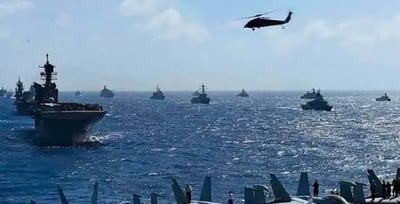
Global maritime balance is undergoing a historic shift as China maintains a continuous presence of approximately one hundred naval vessels and warships across open seas on any given day. For more than seven decades, the United States Navy operated without a peer rival, commanding global sea routes, patrolling international choke points, and projecting undisputed military power across every major ocean. Today, Beijing's rapid shipbuilding output and expansive maritime operations are directly confronting that supremacy, presenting American military planners with an enduring strategic challenge that cannot easily be solved.
The steady presence of Chinese combatants across the western Pacific and adjacent waters marks a dramatic change from earlier decades when Chinese forces remained close to their coastline. Modern satellite tracking and naval intelligence show that Beijing now keeps guided-missile destroyers, modern frigates, supply tankers, and surveillance ships operating simultaneously across the East China Sea, the South China Sea, and deep into the Western Pacific Ocean. This unrelenting operational pace ensures that neighboring countries and international fleets encounter a visible Chinese naval footprint wherever they sail.
At the core of this naval expansion is China's unmatched commercial and military shipbuilding infrastructure. Chinese shipyards now build surface combatants, amphibious assault carriers, and advanced submarines at a pace that exceeds the industrial capacity of Western nations. While American defense manufacturers face maintenance backlogs, skilled labor shortages, and slow drydock turnarounds, Chinese production facilities launch multiple advanced surface combatants each year, steadily widening the numerical gap in total operational hulls.
American defense commanders have expressed growing concern over this continuous operational volume. Operating one hundred warships daily requires extensive logistical support, well-trained crews, and robust underway replenishment systems. The fact that Beijing can sustain this operational tempo proves that its naval forces have moved past basic coastal defense into high-tempo, blue-water maritime operations capable of contesting critical waterways far beyond the first island chain.
The geographical reach of this fleet is expanding well beyond traditional home waters. Chinese task groups regularly conduct complex joint exercises near the Philippine Sea, transit the strategic straits around Japan, and venture into the northern Pacific waters near Alaska. Further west, Chinese warships maintain continuous anti-piracy patrols in the Gulf of Aden, call on friendly ports across the Indian Ocean, and operate from China's dedicated overseas military outpost in Djibouti, demonstrating an active interest in protecting global trade arteries.
This constant maritime pressure creates significant operational strain for the United States and its regional allies. American carrier strike groups and allied naval units must expend considerable resources tracking, monitoring, and shadowed by Chinese vessels during routine freedom of navigation missions. The sheer quantity of opposing ships allows Beijing to establish local numerical superiority during standoffs around disputed reefs and resource-rich fishing grounds, testing the resolve of smaller regional neighbors.
Beyond standard warships, Beijing coordinates its official navy with a vast maritime militia and coast guard fleet equipped with heavy patrol cutters. These civilian-crewed and paramilitary vessels act as a persistent forward presence, reinforcing territorial claims without crossing the threshold into direct armed warfare. This hybrid approach complicates defensive reactions from international partners who must avoid open conflict while defending international maritime conventions.
Military strategists in Washington are responding by restructuring force deployments, investing in long-range anti-ship missile systems, and accelerating uncrewed naval technologies. The Pentagon has also deepened joint maritime coordination with key Indo-Pacific partners, including Japan, Australia, the Philippines, and India. However, defense analysts caution that forging multilateral alliances and building advanced new ships will take considerable time, while the numerical reality of Chinese ships on the water is an immediate everyday fact.
The evolving competition across the seas signals a new era in global power relations where maritime control is no longer a given for any single nation. With Chinese shipyards continuing to deliver new hulls and fleet commanders pushing operational boundaries further from the mainland, the oceans are once again the central arena of geopolitical competition, testing American maritime power in ways unseen since the end of the Cold War.