
Crocodile Attack in Kumaradhara River Ends in Miraculous Rescue of Local Woman
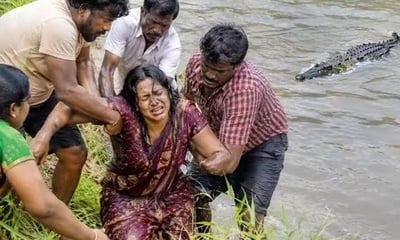
A quiet morning routine turned into a fight for life when a woman was suddenly attacked by a large crocodile along the banks of the Kumaradhara river. The incident took place while she was busy with her daily chores close to the water edge, completely unaware of the danger lurking just beneath the calm surface. In a split second, the water churned violently, and the giant reptile lunged forward to grab her. Her sudden screams broke the peaceful atmosphere of the riverbank, alerting nearby residents that something terrible had happened.
Villagers who were working in nearby fields heard her desperate cries for help and immediately dropped their tools. They did not hesitate for a single second. Recognizing the unmistakable sound of a life or death struggle, several local men and women ran toward the riverbank with sticks, stones, and whatever heavy objects they could pick up along the way. When they reached the muddy shore, they saw a sight that sent chills down their spines. The crocodile had clamped its powerful jaws onto the woman and was attempting to pull her deeper into the strong current of the river.
In nature, when a crocodile drags its prey into deep water, the chances of survival are nearly zero. The woman, however, showed unbelievable courage and refused to give up without a fight. Even while in extreme pain and shock, she used her free hands to strike back at the creature, trying to hit its sensitive eyes and snout. Her struggle bought precious seconds, keeping her close enough to the bank for the villagers to reach her before she was pulled into the deep center of the stream.
Seeing her struggle so bravely, the villagers jumped into action without worrying about their own safety. Some began beating the water with heavy wooden branches to disorient the reptile, while others threw large rocks directly at the animal to force it to release its grip. Two local men stepped directly into the shallow water, grabbing the woman by her arms and upper body. A fierce tug of war took place right there on the slippery riverbank between human courage and wild predatory strength.
Under the continuous barrage of shouts, heavy splashes, and strikes, the crocodile finally lost its grip. Sensing that it was outnumbered and under severe attack, the giant reptile turned back and disappeared silently into the murky depths of the Kumaradhara river. With the predator gone, the rescuers quickly lifted the injured woman out of the water and carried her up the steep embankment to dry, safe ground.
The victim was bleeding heavily and was visibly shaken by the horrific ordeal, but she remained conscious. Without wasting any valuable time, the villagers arranged for a local vehicle to transport her to the nearest government hospital. Medical workers at the health center rushed her straight into the emergency care room. Doctors immediately began cleaning the deep bite wounds to prevent serious bacterial infections, which are very common and dangerous after reptile bites, and started administering fluids, painkillers, and antibiotics.
Hospital authorities later reported that the woman suffered multiple lacerations and soft tissue injuries, primarily on her lower limbs where the crocodile had caught hold of her. Fortunately, the swift intervention by the villagers saved her from fatal injuries, bone fractures, or loss of blood that could have cost her life. Medical staff confirmed that she is in stable condition, resting under observation, and expected to make a full physical recovery with proper care and rest.
News of the incident spread rapidly across neighboring villages along the river basin, causing widespread fear and concern among families who depend on the Kumaradhara river for their everyday existence. For generations, people living along this river have visited its banks every morning and evening to wash clothes, clean utensils, bathe, and fetch water for their cattle and home gardens. The knowledge that such large predators are moving dangerously close to regular human bathing spots has created high anxiety among local households.
Local elders pointed out that wildlife sightings in the area have increased over the recent months. The Kumaradhara river is well known for hosting diverse freshwater aquatic life, including mugger crocodiles. However, villagers noted that attacks on humans have been relatively rare in past years. Many community members believe that changes in water levels, reduced fish populations, and continuous human presence along natural riverbanks may be forcing these reptiles to look for food closer to populated shorelines.
Forest department officials were alerted to the attack shortly after the woman was admitted to the hospital. A team of wildlife rangers visited the spot to examine the riverbank, record footprints, and gather details from eyewitnesses who saw the animal. The forest department issued a public alert, strictly advising all local residents, farmers, and children to stay away from deep water zones and avoid entering the river during early morning hours and late evenings when crocodiles are most active.
To prevent further incidents, forest authorities announced plans to install warning signboards at key access points where people regularly enter the water. Local panchayat leaders have also requested the administration to deploy wildlife watchers along vulnerable stretches of the river. Some village representatives have urged the department to safely capture the problem crocodile and relocate it into deeper, uninhabited forest reserves where human contact is minimal.
This terrifying incident serves as a stark reminder of the fragile balance between human communities and wild animals sharing the same natural resources. While the brave rescue will be remembered as a shining example of unity and bravery among neighbors, it has also highlighted the urgent need for better safety measures, regular monitoring, and clear awareness campaigns along the riverbanks to ensure that ordinary people do not face such deadly hazards while carrying out their everyday lives.