
Forgotten Fossil From Antarctica Identified as First Ever Continental Dinosaur After 40 Years in Storage
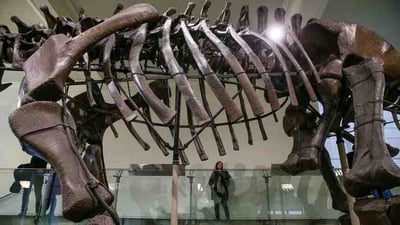
A remarkable case of mistaken identity in the scientific community has concluded with a groundbreaking revelation about the prehistoric past of Earth southernmost landmass. Paleontologists from the British Antarctic Survey in collaboration with the Natural History Museum in London have formally described a forgotten fossil as a genuine dinosaur bone. The unique specimen which is an 82 million year old tail vertebra was originally unearthed in December 1985 by pioneering geologist Dr Mike Thomson during a mapping expedition to James Ross Island on the Antarctic Peninsula. Because the bone was recovered from the Santa Marta Formation, a marine rock layer rich in ancient aquatic life, the field team assumed it originated from an ancient sea creature. Consequently the 10 centimeter wide bone was boxed up, transported to a storage facility in Cambridge, and left completely unstudied in a collection drawer for nearly 40 years.
The incredible truth finally came to light when collections manager and paleontologist Dr Mark Evans was auditing the extensive archives and noticed the unusual physical characteristics of the skeletal remain. Recognizing that the shape did not match known marine creatures Evans contacted global sauropod expert Professor Paul Barrett who instantly identified the distinctive ball and joint sockets unique to terrestrial long necked giants. Their comprehensive scientific analysis published in the journal Acta Palaeontologica Polonica confirmed that the specimen is a tail vertebra belonging to a titanosaur. While this spectacular family of four legged plant eaters contains the largest land animals to ever walk the Earth with some species exceeding 30 meters in length this particular Antarctic resident was a modest 6 to 7 meters long. Researchers are currently unable to verify whether the bone belonged to a juvenile animal or a unique dwarf species that adapted to regional environmental constraints.
This historical reassessment provides critical new evidence that completely reshapes current models of how giant dinosaurs migrated across the ancient southern supercontinent of Gondwana. During the Late Cretaceous period Antarctica was not a frozen wasteland but rather a lush hospitable environment covered in temperate forests and winding rivers kept warm by intense volcanic activity. The presence of a titanosaur on the Antarctic Peninsula strongly suggests that these massive herbivores utilized the landmass as a vital intercontinental bridge to travel directly from South America to New Zealand. This elegant migration theory beautifully explains why titanosaur fossils are found in New Zealand but are entirely absent from Australia which was geographically isolated from this specific western corridor. The fact that this land dweller fossilized in marine sediment indicates that the creature likely died near a coastline and its bloated body drifted out to sea before sinking to the ancient ocean floor.
The extraordinary discovery highlights a significant systemic reality within modern paleontology where major breakthroughs frequently occur inside museum cabinets rather than active field sites. Finding new fossils in Antarctica remains incredibly difficult because thick ice sheets cover 98 percent of the continent, making manual geological exploration a rare and dangerous luxury. This means that existing archived collections brought back by historical expeditions hold an immense volume of hidden data waiting to be decoded by modern analytical technologies. As global climate change accelerates the retreat of coastal glaciers more pristine rock layers will inevitably become exposed to researchers. This newly identified tail bone serves as an inspiring reminder that the mysteries of our planet are often hiding in plain sight and that a single mislabeled artifact can rewrite the natural history of an entire continent.