
Israel Declares Over 2.5 Million Square Metres In West Bank As State Property Paving Way For Talmonim Settlement Expansion Near Ramallah
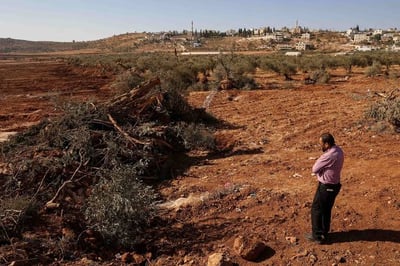
Israeli authorities have issued a sweeping administrative order declaring 2,536,440 square metres of land in the occupied West Bank as state property, placing the vast tract directly under the control of Israel property custodian. The designated parcels span the Palestinian villages of Beitillu, Al-Mazra'a Al-Qibliya, and Deir Ammar, situated northwest of the administrative hub of Ramallah. The formal classification marks one of the most substantial land reclassifications in the governorate in recent months, raising immediate alarm among Palestinian agrarian communities and legal monitoring organizations who warn that the move will accelerate settlement growth and fragment Palestinian territorial continuity.
According to data released by the Palestinian Wall and Settlement Resistance Commission, the reclassified territory is distributed across multiple registered land parcels, including Natural Blocks 1 and 6 in Beitillu, Blocks 2, 3, and 6 in Al-Mazra'a Al-Qibliya, and Block 5 in Deir Ammar. Under the administrative procedure announced alongside the order, local landowners and village residents have been given a 45-day window to file formal legal objections with the Objections Committee at the Ofer military camp. However, Palestinian human rights advocates note that challenging state land declarations within the Israeli military court system faces steep legal barriers, as authorities require extensive documentation of continuous cultivation and title registries that date back decades.
Spatial analysis conducted by monitoring groups reveals that the newly designated state land is strategically positioned to reinforce the Talmonim settlement bloc. The land reclassification provides direct geographical connectivity linking the Israeli settlements of Kerem Reim, Neria, and Nahliel with the surrounding outposts of Talmon and Dolev. By consolidating control over open agricultural corridors between Halamish, Ateret, and the Talmonim cluster, the designation effectively tightens the geographical cordon around Palestinian villages, isolating rural farming communities from their hereditary olive groves and grazing hillsides.
The declaration comes amid a prolonged acceleration of settlement expansion across the West Bank, where right-wing political figures within the Israeli governing coalition have pushed to streamline bureaucratic procedures for settlement building and infrastructure integration. Declaring uncultivated or unregistered parcels as state land has historically served as the primary legal mechanism under Israeli military administration to allocate land for housing units, security bypass roads, and public utility corridors reserved for Israeli settlers. The policy has drawn recurring condemnation from the United Nations, the European Union, and international human rights bodies, which maintain that all Israeli settlements in occupied territory violate the Fourth Geneva Convention and international law.
Local municipal councils across Beitillu, Al-Mazra'a Al-Qibliya, and Deir Ammar have begun coordinating emergency legal efforts to challenge the military decree before the 45-day deadline expires. The Settlement Resistance Commission urged affected farmers and families to urgently gather historical tax receipts, cadastral records, aerial photographs, and documented proof of land tenure to substantiate ownership claims. Community leaders have also emphasized the need to compile records of physical attacks, roadblock closures, and settler harassment that have prevented local farmers from safely accessing and tilling their lands in recent harvest seasons, arguing that forced exclusion cannot legally justify state confiscation.
The move is poised to intensify diplomatic scrutiny over Israeli policies in the West Bank as tensions remain elevated across the Palestinian territories. For Palestinian residents living northwest of Ramallah, the conversion of open village lands into state property threatens their agricultural livelihoods, restricts municipal development, and further undermines the viability of a contiguous future Palestinian state.