
Turkiye Parliament Ratifies Historic Mecca Defence Agreement With Saudi Arabia And Pakistan Pledging Mutual Military Protection Amid Rising Houthi Attacks
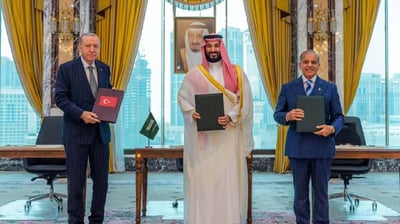
The Grand National Assembly of Turkiye has officially ratified the landmark Mecca Joint Defence Agreement with Saudi Arabia and Pakistan, formalizing a trilateral mutual security framework that includes a collective defense clause. The legislative measure passed with 279 votes in favor and 119 against in the 600-seat Turkish parliament, completing the final domestic approval stage required for the pact after Saudi Arabia and Pakistan concluded their respective ratifications. The approval marks a significant strategic realignment across West Asia and the Gulf, committing NATO second-largest military to collective deterrence and defensive coordination alongside Riyadh and Islamabad.
The agreement stems from a 16-article treaty initially signed in the holy city of Mecca on August 7, following months of high-level diplomatic and military negotiations. Under the core collective security provisions of the pact, an armed military attack on any of the three signatory nations is considered an attack against all three. In addition to collective deterrence, the treaty establishes formal mechanisms for regular intelligence sharing, joint military exercises, interoperability drills, and expanded collaboration in defense industry production and weapons procurement. Retired Pakistani Lieutenant General Nauman Mahmood has been appointed as the first secretary-general of the joint defense mechanism for a three-year term to oversee implementation.
The parliamentary vote comes as Saudi Arabia contends with renewed cross-border strikes, missile launches, and drone attacks launched by Yemen Iran-backed Houthi movement. Although Riyadh has frequently condemned Houthi attempts to threaten commercial shipping lanes and territorial integrity, the ratification opens the door for enhanced Turkish technical assistance, radar coordination, and advanced air defense support to shield vital Saudi energy installations and infrastructure. The treaty will formally take effect upon publication in Turkiye Official Gazette, with the executive administration overseeing bilateral operational coordination.
The ratification prompted spirited debate on the floor of the Turkish parliament, where opposition lawmakers voiced concerns about the risk of Ankara becoming entangled in foreign conflicts. Opposition leaders argued that the arrangement could draw Turkish soldiers into prolonged regional warfare in Yemen, invoking the deep historical memory of Ottoman military losses in the Arabian Peninsula during the early twentieth century. Lawmakers from the secular Republican People Party (CHP) and the New Party demanded clear procedural limits, warning against Turkiye assuming the defensive burdens of regional partners without rigorous civilian oversight.
In response to legislative pushback, senior officials representing President Recep Tayyip Erdogan ruling Justice and Development Party (AK Party) emphasized that the pact remains strictly defensive. Fuat Oktay, chairman of the parliamentary foreign affairs committee, assured the assembly that Turkiye will not be dragged into any uncontrolled foreign conflict against its sovereign will. Government ministers reaffirmed that while the treaty pledges mutual solidarity, the actual deployment of Turkish combat troops onto foreign soil is not automatic under the text and would strictly require a separate, explicit authorization mandate from the Turkish parliament under national constitutional law.
Regional observers view the ratification as a defining shift in West Asian security architecture, bringing together a NATO member, a nuclear-armed South Asian state, and the leading economic power in the Gulf. By consolidating ties with Riyadh and Islamabad, Ankara expands its diplomatic reach, positions its booming domestic defense manufacturing sector as a central hardware supplier for allied militaries, and cements its role as a pivotal security actor across the Red Sea and Arabian Gulf corridors.