
Jamia Students Protest Did Not Raise Free Kashmir Slogans Says Congress MP Imran Masood After Police Detention
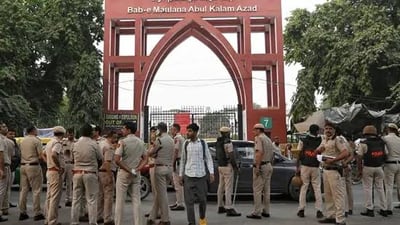
Congress party lawmaker Imran Masood has firmly clarified that students staging demonstrations at Jamia Millia Islamia did not shout any slogans calling for a free Kashmir. The member of parliament visited the central university campus in the national capital to speak directly with young learners who have been carrying out peaceful demonstrations over long standing administrative grievances. Shortly after his interaction with the protesting youth on the campus grounds, security officers from the local police department placed the lawmaker under temporary detention to control the growing assembly outside the premises.
Speaking immediately after the police intervention, the political leader expressed complete rejection of claims suggesting that the student community was involved in raising anti national slogans. He affirmed that not a single word opposing the territorial unity of the country was spoken by the gathering. Standing before the gathered crowd, he reiterated that Jammu and Kashmir is an integral and inseparable part of the Indian nation and will always remain so. He emphasized that even a small child in the country understands this basic truth and respects national boundaries without question.
The controversy began when certain posters referring to Jammu and Kashmir surfaced near the protest area, causing widespread debate across political circles and news platforms. The lawmaker condemned the individuals behind those paper displays, saying that such actions were deliberate attempts by mischievous outside elements to weaken the genuine demands of the young learners. He called upon police authorities to conduct an impartial investigation and take strict legal action against anyone who pasted the misleading posters to divert attention away from genuine campus problems.
The demonstration at the university was organized around basic academic and institutional rights, primarily the demand to bring back the elected student union. For several years, students have asked the university administration to conduct democratic elections so that regular learners have a recognized voice to speak with college authorities regarding hostel facilities, library hours, examination fees, and campus amenities. The lawmaker questioned why the administration appeared hesitant to restore democratic representation, arguing that college students represent the future leadership of the nation and should be encouraged rather than silenced.
Several young men and women had also started an open hunger strike near administrative offices to demand that their voices be heard without bureaucratic delays. Living on plain water for multiple days, the hunger strikers urged college officials to sit across the table and discuss campus welfare in a transparent manner. The political leader stated that painting such student movements with controversial labels is deeply unfair to young scholars who are simply asking for better learning conditions and fair treatment within their own educational institution.
Following the prolonged agitation and growing public attention, senior leaders of the university administration convened an emergency meeting to address the rising unrest. High ranking administrative heads, including the Vice Chancellor, the university Registrar, faculty deans, the Dean of Students Welfare, the Chief Proctor, and hostel provosts, gathered together on October 18 to review the complaints raised by the demonstrators. The university authorities decided to establish a high level committee tasked with holding direct talks with the students, examining their demands closely, and recommending practical solutions to restore normal academic functioning across the campus.
The lawmaker argued that central universities are places where healthy debates and civic awareness must flourish freely. When youth raise questions about their educational environment, authorities should respond with dialogue rather than heavy police action or criminal allegations. By branding ordinary campus protests with sensitive geopolitical issues, the real problems of common students get pushed aside. He urged community members, political parties, and administrative leaders to look at the situation with fairness and prioritize the welfare of the studying youth.
The episode highlights how student demonstrations in large metropolitan universities frequently face intense scrutiny from outside observers. Often, small incidents or unverified materials get amplified rapidly, shifting the focus away from primary campus issues like hostel allotments, fair representation, and student welfare. With the newly appointed administrative panel scheduled to open direct communication channels with student representatives, both teachers and students hope that the campus will soon return to a peaceful academic atmosphere where daily classes and examinations proceed without disturbance.