
Priyanka Gandhi Backs Son Raihan Vadra as Bikaner House Removes 74 Protest Photographs From Exhibition
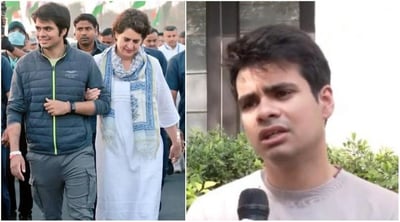
A major political and cultural storm has erupted in the national capital following the sudden removal of dozens of photographs from a solo art show inside Bikaner House. Visual artist and photographer Raihan Vadra, the son of senior Congress party leader Priyanka Gandhi Vadra and businessman Robert Vadra, saw seventy-four out of one hundred and five images ordered off the exhibition walls just hours before the opening event. The photographs captured intense moments from recent youth demonstrations on Delhi streets, sparking an immediate clash over administrative censorship and artistic freedom.
Congress leader Priyanka Gandhi Vadra arrived at the venue to stand firmly behind her son, stating that he must always stand up for what is true. Speaking to reporters at the gallery, she strongly criticized the decision of the administration, describing the move as a clear attempt to silence young citizens across the country. She emphasized that the photographs were simple visual documents capturing real public demonstrations without any insulting or hateful commentary, warning that silencing an artist shows that democratic values are being pushed aside.
The young artist revealed that gallery administrators contacted his team late in the afternoon, delivering an ultimatum that if the designated images were not pulled down within ninety minutes, the entire show would be cancelled. Faced with the immediate threat of having the entire venue shut down, Vadra agreed to remove the frames, leaving bare red walls, exposed nails, and exhibition catalogues showing visitors what had been taken away. He expressed deep disappointment, explaining that he had submitted the entire layout and proposal to the management weeks before the event without receiving any prior objections.
The images taken down by the authorities captured recent demonstrations organized by student and youth groups around Jantar Mantar and central government buildings. Vadra pointed out that several of the removed frames featured everyday demonstrators holding the national flag, adding that he found it shocking for authorities to object to simple pictures of the tricolor. To draw attention to the missing artwork, the organizers placed printed copies of the Preamble to the Indian Constitution along the empty display spaces.
Responding to the growing public controversy, the Bikaner House Management Society released a statement explaining their decision to intervene. The administration maintained that the venue is dedicated to cultural exchanges, arts, and heritage, and is governed by strict rules against political messaging. Officials stated that several frames selected for display were found to be inconsistent with venue regulations and historical preservation guidelines, which led the committee to request their immediate removal before opening the doors to general visitors.
Opposition leaders quickly rallied around the young photographer, turning the gallery incident into a broader debate on constitutional liberties. Several members of parliament called the sudden removal unreasonable and heavy-handed, arguing that art cannot be separated from current public realities. Senior political figures questioned why pictures of peaceful street gatherings should be treated as objectionable material in a democratic capital, accusing government bodies of fearing visual documentation of public grievances.
Leaders from the ruling Bharatiya Janata Party responded with sharp counterattacks, accusing the Gandhi family of manufacturing public drama to advance their political interests. Party spokespersons claimed that the family was attempting to create an artificial controversy to draw media attention and promote the young artist in the public sphere. Government supporters argued that venue guidelines apply equally to every citizen, regardless of their family lineage, and that historical government spaces should not be turned into platforms for one-sided political demonstrations.
Defending his creative choices, the twenty-six-year-old artist maintained that photography must reflect the truth of the world around us. He stated that taking photographs of demonstrations is a normal civic duty for visual chroniclers, rejecting claims that visual documentation should be banned from cultural halls. Despite the heavy cuts to his collection, Vadra confirmed that the exhibition, titled No Idea Is Final, would remain open to the public and that he intends to locate an alternative gallery space to show the complete collection of images in the future.
The standoff at Bikaner House highlights the deep friction between official regulations and creative expression in contemporary India. Cultural observers point out that while historical exhibition centers often enforce guidelines to avoid partisan political campaigns, applying sudden bans right before an opening sets a concerning precedent for independent creators. As visitors walk past the empty red walls in central Delhi, the blank spaces have themselves become a powerful talking point regarding the limits of artistic expression.