
Mob Attacks Trinamool Leader Abhishek Banerjee As Mamata Banerjee Blames Incident On BJP
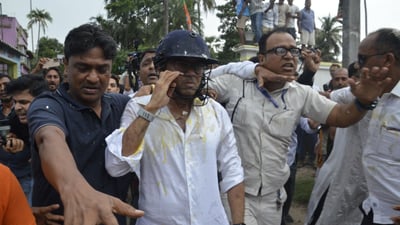
The political landscape of West Bengal has been thrust into intense turmoil following a violent physical confrontation targeting a prominent legislative representative. During a scheduled political mobilization drive in the Sonarpur municipality, a large and aggressive crowd unexpectedly breached security perimeters to surround the national general secretary of the All India Trinamool Congress, Abhishek Banerjee. The situation rapidly escalated from vocal protests into a direct physical assault, forcing a combined team of state police and central security personnel to form a protective human shield around the targeted leader. Security forces struggled for a considerable duration against the surging crowd to safely extract the lawmaker from the venue, deploying emergency vehicles to navigate through the hostile environment as local demonstrators pelted stones and clashed with party loyalists.
Immediately following the violent disruption, Chief Minister Mamata Banerjee launched a scathing public attack against the federal opposition, directly holding the Bharatiya Janata Party responsible for orchestrating the physical encounter. Addressing a hastily arranged press briefing, the state leader alleged that the central ruling party is actively deploying aggressive, state sponsored violence to intimidate regional political opponents and disrupt local campaign efforts. She asserted that the opposition, unable to counter her party organizational strength through democratic voting means, has resorted to generating widespread civic chaos and utilizing local agitators to launch targeted ambushes against senior leadership figures. This intense rhetorical escalation has pushed the ongoing regional rivalry to a dangerous peak, with both major political factions trading heavy accusations over who holds responsibility for the breakdown of public order.
From an analytical viewpoint, this latest security breach highlights the fragile nature of democratic engagement and the severe polarization affecting the regional administrative framework. While the ruling party attributes the incident entirely to external political manipulation, local investigative reports suggest that underlying public anger regarding localized developmental grievances and municipal performance also played a key role in fueling the sudden confrontation. By dismissing all forms of local public friction as simple opposition conspiracies, the state administration risks ignoring genuine systemic distress among rural and semi urban voter bases. Furthermore, the fact that central security forces had to intervene directly inside a state managed jurisdiction emphasizes a growing institutional friction between local law enforcement capabilities and federal security deployments, creating a complex governance gridlock where security management is constantly filtered through a lens of partisan politics.
Ultimately, this dramatic escalation serves as a critical warning regarding the eroding standards of political discourse and the rising acceptance of physical intimidation within competitive state politics. Following the targeted confrontation, law enforcement agencies launched an extensive crackdown across the Sonarpur region, detaining dozens of suspected agitators and establishing strict temporary restrictions on public gatherings to prevent retaliatory violence between rival party cadres. While political parties continue to utilize these volatile events to rally their respective support bases and project victimhood, the repeating pattern of violence threatens to alienate ordinary citizens from active participation in the democratic process. Moving forward, restoring absolute political stability will require both federal and state institutions to prioritize institutional accountability and enforce strict legal boundaries, proving that a sustainable democracy cannot function when physical violence replaces peaceful debate on the ground.