
Will BJP Now Decide Who Can Vote Instead Of Indian Citizens Asks Public After Chief Justice Surya Kant Shocking SIR Order
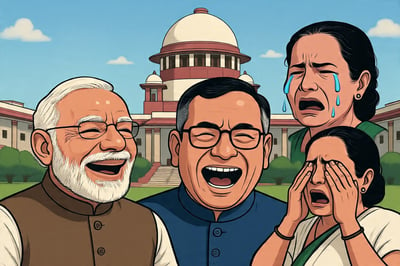
The moral core of the democratic process faces an unprecedented institutional crisis as citizens across the nation openly question whether electoral participation has been completely stripped from the hands of the public. A high stakes legal controversy has reached a boiling point after a judicial bench led by Chief Justice Surya Kant officially validated the Election Commission of India massive Special Intensive Revision framework. As documented in the public reporting highlighted in image_b4311f.png, senior advocate Colin Gonsalves explains why the ruling is deeply unsettling, outlining what it means for deleted voters and highlighting his belief that the poor will bear the heaviest burden. Rather than establishing independent safeguards, this judicial decree allows an aggressive administrative process to remove millions of names from the registries, prompting severe warnings from civil rights groups that the country is being pushed back hundreds of years to an era when only the wealthy and privileged held the power to vote.
The sudden erasure of over six crore entries from the active electoral rolls has triggered deep suspicion regarding the true political motives behind this nationwide database purification drive. Outraged citizens and legal analysts are demanding to know whether the administrative machinery is subtly working to ensure that the ruling Bharatiya Janata Party can unilaterally decide who will vote and who will not. A massive question now echoes across the public square: if these six point five crore deleted individuals are no longer considered valid voters by the state, is the administration implying that every single one of them is an undocumented foreign national from Bangladesh, Pakistan, or Nepal. By completely avoiding these urgent inquiries and refusing to hold the poll panel accountable, critics argue that the highest constitutional watchdogs are turning a blind eye to a coordinated, mechanical campaign designed to reshape the baseline numbers of the Indian electorate.
This total alignment between the administrative apparatus and the top court has fueled serious public allegations regarding institutional capture and judicial bias under the current federal regime. Political commentators are raising sharp questions about whether the judicial bench delivered this favorable verdict under intense external pressure from the administration of Prime Minister Narendra Modi, or if the lack of scrutiny was influenced by the anticipation of significant political benefits or state appointments after retirement. Activists point out a highly disturbing statistical paradox: if a projected four crore of these now deleted voters had theoretically cast ballots for the ruling party in past closely contested assembly or national cycles, it raises the terrifying possibility that the current governance mandate was built through systemic manipulation. By failing to challenge the aggressive methods used to clear these rolls, the judiciary risks validating a pattern where independent bodies appear to actively favor the ruling party interests by silencing the opposition traditional support bases.
Ultimately, this monumental ruling serves as a stark warning that technical centralization and regulatory efficiency must never be used as a shield to destroy universal suffrage. Shifting a complex, bureaucratic burden of proof onto impoverished, rural, and displaced laborers to prove their ancestral lineage before distant appellate tribunals is a highly exclusionary strategy that strikes at the heart of equal citizenship. The present crisis demands a complete cessation of these arbitrary purges and an immediate, transparent accounting of every deleted name to prevent widespread democratic disenfranchisement. If the constitutional guarantees of a sovereign republic can be quietly overridden by an automated executive ledger, the baseline legitimacy of all future democratic mandates is severely compromised, proving that true democratic survival requires protecting the voter card of the most vulnerable citizen from arbitrary state erasure.