
NDIA Bloc: Can 23 Opposition Parties Fix Cracked Walls At High-Stakes Delhi Meeting?
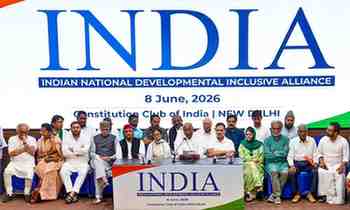
The highly anticipated national conclave of the opposition coalition at the Constitution Club in New Delhi brought together 23 political parties on Monday, attempting to present a powerful front against the ruling government. Led by top political figures including Mallikarjun Kharge, Rahul Gandhi, Sonia Gandhi, Akhilesh Yadav, and Mamata Banerjee, the gathering focused on constructing a unified national campaign around pressing economic issues. Independent Rajya Sabha MP Kapil Sibal also joined the high level meeting, adding further weight to the discussions. The top leadership utilized this crucial floor coordination meeting to address mounting pressure over the national economic slowdown, escalating fuel prices, inflation, and public anxieties surrounding paper leaks. By building a shared platform on these public grievances, the coalition is attempting to realign its strategy for upcoming state elections and the 2029 general elections.
However, the public display of unity could not completely hide the significant friction shaking the foundations of the alliance. The most severe blow came from the south, as the Dravida Munnetra Kazhagam completely boycotted the Delhi event, citing a massive political betrayal by the Congress party. This dramatic fallout occurred after the Congress decided to dump its long standing partner to join hands with actor politician C. Joseph Vijay and his party, the Tamilaga Vettri Kazhagam, to form a new government in Tamil Nadu. The political landscape has shifted so drastically that the southern group has officially petitioned the Lok Sabha Speaker to assign them separate seating away from the Congress benches in Parliament. Meanwhile, the Aam Aadmi Party also maintained its distance from the national meeting, pointing to the reality that it remains the principal rival to the Congress party in Punjab.
Internal friction extended beyond the southern borders, showing that local electoral survival often clashes with national coalition goals. The Communist Party of India Marxist sent its representative to the venue but demanded immediate answers regarding bitter election campaigns in Kerala, where local leaders traded heavy accusations of secret deals with the ruling central party. Simultaneously, the Jharkhand Mukti Morcha expressed deep unhappiness over unilateral candidate announcements for the upcoming Rajya Sabha elections. Even West Bengal presented a complicated dynamic, where the coalition partners recently fought a bitter state assembly election against each other. Although Mamata Banerjee adopted a highly cooperative approach in Delhi following recent regional challenges, the ground reality proves that local rivalries continue to pull the national alliance in completely opposite directions.
The ultimate success of this large political gathering depends on whether these regional forces can truly look past their local survival instincts to build a lasting national alternative. While senior leaders emphasize that the alliance represents a massive portion of the Indian electorate, the ongoing friction reveals a deeper structural weakness. The ruling central party will undoubtedly capitalize on these visible fractures, rendering a fractured opposition less effective in challenging major policies. Moving forward, the coalition must establish a formal dispute resolution mechanism if it wants to prevent sudden local betrayals from ruining national coordination. Without addressing these core regional grievances, the show of strength in New Delhi will remain a temporary arrangement rather than a sustainable political force capable of lasting until 2029.