
Nepal Flash Flood: Principal Evacuates 1,643 Schoolchildren Minutes Before Glacial Debris Sweeps Himalayan Campus in Nuwakot
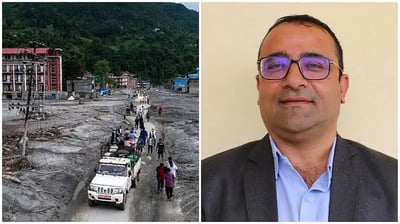
A normal morning assembly transformed into a desperate fight for survival when an educator in the Himalayan foothills received a single urgent warning. Rajendra Dawadi, a 47-year-old English teacher and principal of Tribhuvan Trishuli Secondary School, made a split-second call that prevented one of the worst school disasters in modern history. Situated in Nepal’s Nuwakot district, the three-storey concrete campus seemed secure, standing roughly 60 meters above the riverbed. Yet, within a matter of minutes, that solid structure was wiped off the map by a massive wall of glacial silt, rock, and freezing water.
The alarm was first raised when an urgent phone call reached the principal from a friend living in Betrawati, an upstream settlement roughly five miles away. The voice on the line was breathless, explaining that an entire village along the upper river system had already been washed away and urging everyone down the valley to run immediately. Moments later, a local parent sprinted through the school gates to confirm that the river was climbing at a terrifying rate. Recognizing that there was zero time to deliberate, the principal immediately reached for the emergency bell.
Classroom doors swung open as teachers responded instantly to the continuous alarm. The campus housed approximately 900 students who were already seated inside their rooms, while another 700 were on foot nearby or traveling on packed school transport buses, each carrying dozens of students. Moving swiftly, the administrative staff began calling bus drivers along the mountain routes, ordering them to turn back before entering the narrow valley floor. The students poured out into the courtyard, leaving behind their bags, books, and footwear in the rush to escape.
The evacuation route led straight uphill, away from the riverbanks and toward elevated mountain terraces. The physical and mental strain took an immediate toll on the young students, with one girl experiencing a severe panic attack before being rushed up the mountain trail on the back of a motorbike. The rest of the children, guided by their teachers and followed by the principal, climbed the rugged slope on foot until they reached the sheltering canopy of an old bodhi tree located on a safe ridge.
From that elevated vantage point, the students and staff watched the disaster unfold with horror. A roaring deluge of mud, massive boulders, splintered timber, and glacial ice surged through the Trishuli Valley floor. The raging torrent tore through infrastructure, took down bridges, and smashed directly into the school grounds, reducing the three-storey concrete building to rubble within minutes. Despite the complete physical destruction of the campus, all 1,643 enrolled children survived unharmed.
The tragedy, however, did not spare the broader school community. Two staff members lost their lives after turning back into dangerous zones. Santos Pariyar, a 32-year-old social history teacher, was swept away by the rising water after returning to his rented quarters near the riverbank to cook breakfast. Sultan Lama, the dedicated school janitor, was also caught in the floodwaters after going back inside the main building to ensure the doors were secured behind the fleeing children.
The catastrophic event occurred on the morning of Wednesday, August 26, 2026, when an enormous section of ice and rock broke away from the slopes of Langtang Lirung peak near the border between Nepal and Tibet. The massive detachment plunged nearly 1,200 meters into the steep upper gorge of the Lhende Khola river. The force of the impact pulverized rock into sediment, which mixed with water to form a high-density debris flow capable of generating seismic tremors that registered across regional monitoring stations.
Across the wider region, the scale of devastation has been severe. Official disaster response agencies in Nepal have reported that the death toll has exceeded 750, with more than 2,500 people remaining unaccounted for. Downstream infrastructure suffered massive damage, including the inundation of tunnels at the Trishuli 3A hydropower project where dozens of workers were trapped. International search and rescue teams from neighboring India and China have been deployed with specialized heavy equipment and aerial support to assist local authorities in clearing debris and tracing missing residents.
The survival of the students highlights the critical importance of human agency, informal warning networks, and decisive leadership during sudden-onset environmental emergencies. In mountainous regions where automated monitoring systems can be disrupted or delayed by severe terrain, the quick decision of a local community leader to prioritize human life over property made the ultimate difference between total survival and unimaginable tragedy.