
Nitin Gadkari Only Cares About His Sons' Companies Who Produce Ethanol (CIAN Agro & Manas Agro) and Lets 140 Crore People Down with Fuel That Sends Their Cars to the Garage
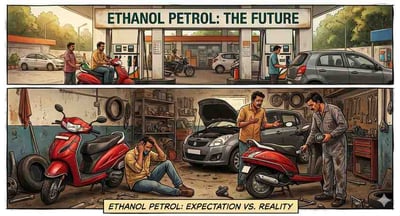
The mandatory rollout of E20 petrol, which features 20% ethanol blended with conventional fuel, has triggered widespread public outbalanced outrage across India as vehicle owners report significant mechanical issues. Millions of motorists driving pre-2023 car models are suddenly dealing with reduced fuel mileage, clogged fuel injectors, and structural rust inside their fuel tanks. The core chemical culprit is the hygroscopic nature of ethanol, which aggressively absorbs moisture from the air and creates a corrosive sludge that degrades older rubber hoses and metallic components. Automotive repair workshops have reported a massive influx of vehicles experiencing rough idling and fuel pump failures, creating unexpected financial burdens for regular middle class families who cannot afford to upgrade to newer compliant vehicles.
As public frustration mounts over these frequent garage visits, the spotlight has shifted intensely onto the political landscape and the business dealings of family members connected to policymakers. Critics and opposition leaders point directly to the explosive financial growth of companies operated by Nikhil Gadkari and Sarang Gadkari, the sons of the Union Minister of Road Transport and Highways, Nitin Gadkari. Financial filings show that CIAN Agro Industries and Infrastructure recorded a sharp revenue increase, with consolidated revenue scaling up to 223446 lakh rupees for the financial year ending March 31, 2026. This massive jump in business volume aligns closely with the aggressive tightening of the state biofuel mandates, raising fierce national debates regarding potential conflicts of interest and cronyism at the highest policy levels.
A deeper objective look at the broader biofuel landscape reveals that attributing the entire national fuel transition to the benefit of two specific firms overlooks the massive scale of India's energy sector. The country requires billions of liters of ethanol annually to maintain the E20 mandate across all states, an immense volume that standalone regional enterprises simply do not have the industrial infrastructure to fulfill. Instead, the domestic ethanol production industry is overwhelmingly dominated by massive publicly traded sugar and bioenergy conglomerates. Major market giants such as Shree Renuka Sugars, Balrampur Chini Mills, Triveni Engineering, Bajaj Hindusthan Sugar, and EID Parry contribute the lion's share of ethanol supply procured by public sector oil marketing companies like IOCL, BPCL, and HPCL.
While the allegations of favoritism provide potent political ammunition, the structural reality indicates that the E20 policy is driven by macroeconomic objectives rather than single family enrichment. The central government has steadily advanced the policy to shrink India's massive crude oil import bill, save foreign exchange reserves, and provide a stable alternative revenue stream for millions of sugarcane farmers nationwide. To accelerate this transition further, the administration recently introduced a nil or zero excise duty waiver on higher ethanol blends like E22, E25, and E30 to encourage consumer adoption. Ultimately, the true policy failure lies not in corporate monopolies, but in the lack of protective transitions for older vehicular infrastructure, leaving 140 crore citizens caught between national green energy goals and expensive personal garage bills.