
PM Modi Flags Three Enemies Of India Urging Political Parties And National Institutions To Stand United In Supreme National Interest
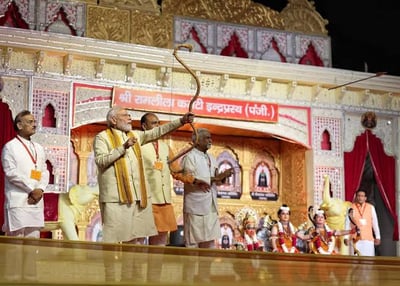
A powerful call for countrywide harmony and collective responsibility has been made by Prime Minister Narendra Modi, who urged citizens, public institutions, and political groups across the ideological spectrum to unite for the supreme interest of the motherland. Speaking to a vast gathering of citizens, community leaders, and public figures, the Prime Minister highlighted that internal division and negative narratives weaken a nation from within. He declared that the time has come for all responsible forces to rise above daily partisan disputes, align their broader thoughts, and work together with a single shared purpose to ensure that the dignity and sovereignty of the land remain unshakable.
The central theme of the address focused on identifying three major internal and ideological dangers that threaten India's ongoing growth, stability, and civil order. The Prime Minister explicitly named these three destructive forces: elements that hurt the honor and standing of the country, individuals and factions that actively divide society along fault lines, and the mindset of those who harbor hatred toward native culture and traditions. He described these three forces as direct enemies of the country and insisted that every responsible citizen and constitutional body must learn to recognize them clearly and defeat their harmful designs.
Addressing political leaders and democratic organizations, the Prime Minister appealed for a fundamental change in how national matters are approached. He pointed out that while differences in policy, party goals, and political ideologies are completely normal in a thriving democracy, such rivalries must never come at the expense of national security or public peace. Quoting ancient wisdom that highlights collective thinking and shared purpose, he noted that when the security, honor, and foundational strength of the nation are at stake, all political parties and public institutions must speak with one single, firm voice.
The speech was delivered during the grand Vijayadashami celebrations held in east Delhi, marking the traditional festival that celebrates the victory of good over evil. As the traditional effigies of Ravana were burned to signify the destruction of falsehood, the Prime Minister drew meaningful lessons from the life and conduct of Lord Ram. He explained that the ancient epic offers vital teachings for modern state building, showing how ordinary people, when brought together with shared trust and strong resolve, can bridge impossible gaps and achieve monumental victories against overwhelming odds.
Building on that thought, the Prime Minister highlighted self-reliance as an urgent practical necessity rather than just an economic slogan. He warned that a nation cannot afford to sit back relying on foreign assistance or outside powers to fix its internal challenges. India must have total confidence in its own resources, its own local workforce, and the creative talent of its people. He urged families and industries to turn their collective will into productive energy, solving domestic problems through native hard work and building an independent economic framework that cannot be pressured from the outside.
The Prime Minister also expanded on the concept of Ram Rajya, defining it as an enduring benchmark for honest, transparent, and fair public administration. He stated that true governance is one where discrimination finds no place, where ordinary citizens receive timely justice, and where equal opportunities are open to everyone regardless of social status. He reminded those in public life that political power is never meant for dominating citizens or exercising personal control, but exists purely to serve the welfare of the poor, the marginalized, and the deprived sections of society.
The remarks on cultural pride and social unity come at a time when public debates over heritage, community harmony, and political rhetoric have become increasingly sharp across the country. By warning against mindsets that attack native traditions and generate social hostility, the Prime Minister sought to make cultural pride a unifying pillar of national development. He underscored that cultural identity is the living root that keeps a great civilization steady, and undermining that identity leaves a society vulnerable to fragmentation and self-doubt.
Political observers and public commentators note that the Prime Minister's call represents an effort to build a common minimum consensus across political divides at a time of complex global uncertainties. By asking political rivals to find shared ground on national dignity and security, the message sets a challenging benchmark for domestic public debate. As the country pursues its ambitious goals of economic expansion, infrastructure growth, and global influence, the call to defeat division and put the nation first sets the stage for how political leadership and public institutions are expected to conduct themselves in the days ahead.