
Russian Drone Strike on Kyiv Ammunition Depot Kills 38 People as Secondary Explosions Ravage Residential Village of Myla
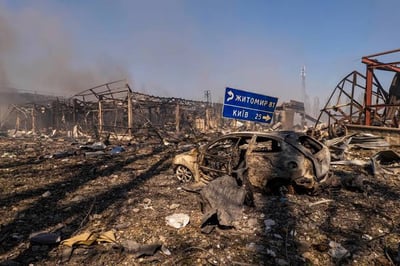
A quiet village situated just west of the Ukrainian capital was shaken by catastrophic explosions when an aerial strike struck a concealed military storage depot, turning a residential neighborhood into a scene of severe destruction. Residents in the village of Myla, located along the busy highway connecting Kyiv with western regions, were startled by the sudden approach of an unmanned aircraft before a powerful detonation tore through the area. Within seconds, a storage facility holding heavy military ordnance caught fire, setting off a chain reaction of violent secondary blasts that sent shrapnel, unexploded shells, and thick smoke across surrounding homes and gardens.
The sheer intensity of the detonations caught local emergency workers and nearby families completely off guard. Buildings across the neighborhood suffered shattered windows, collapsed roofs, and heavy structural damage as multiple blasts continued for hours. Emergency rescue teams, local volunteers, and neighbors rushed into the danger zone to pull injured survivors from the rubble, even as smaller explosions continued to ignite across the perimeter. Local community leader Taras Didych, who served as the head of the surrounding territorial district and rushed to organize the initial evacuation effort, was tragically killed when further detonations rocked the blast site.
The human toll made the disaster the single deadliest incident in the Kyiv area this year. Rescue workers recovered thirty-eight bodies from the flattened buildings and damaged streets, while more than twenty people, including two young children, were transported to regional hospitals with severe trauma, burns, and shrapnel injuries. Search teams worked through debris heaps and cleared unexploded munitions from private yards, while four residents remained unaccounted for beneath the wreckage. Families who lived in the vicinity described scenes of utter panic, with many forced to flee their homes empty-handed as hot metal rained down across local roads.
The devastating scale of the tragedy triggered an immediate domestic outcry and strong reactions from Ukraine’s top leadership. President Volodymyr Zelenskyy delivered a direct public address expressing profound sorrow for the victims while directing sharp criticism at the military and logistical authorities responsible for managing ordnance sites. The president declared that placing large stockpiles of volatile munitions, explosive components, and rocket boosters right next to civilian homes was an unacceptable error of judgment that placed innocent lives directly in harm’s way. He demanded immediate accountability from the defense sector, emphasizing that national defense must never compromise the fundamental safety of citizens living behind the front lines.
Prime Minister Serhii Koretskyi echoed these concerns, announcing comprehensive government oversight to determine why hazardous military assets were kept in such close proximity to dense residential communities. The Security Service of Ukraine alongside the State Bureau of Investigation initiated formal criminal proceedings into allegations of military negligence and regulatory violations regarding the transport and storage of hazardous materials. Simultaneously, the Ministry of Defence ordered an emergency audit of every logistics center, warehouse, and storage depot across the nation to ensure that ordnance is kept at safe distances from populated civilian centers.
The catastrophe occurred on Friday, August 28, 2026, when a jet-powered Russian attack drone managed to slip past regional air defense systems and strike the warehouse compound. The facility was being used to hold an extensive assortment of munitions, including artillery shells, anti-tank landmines, drone parts, and high-energy booster units destined for active combat formations. When the drone struck the main structure, the intense heat and shockwave instantly breached storage containers, triggering a self-sustaining cycle of detonations that overwhelmed initial fire-suppression attempts and scattered hazardous remnants across several square kilometers.
The tragedy in Myla followed a concerning pattern that has drawn increasing scrutiny from local residents and civic organizations. Only weeks earlier, an ammunition storage blast occurred in the nearby town of Vyshneve, claiming ten lives and damaging neighboring apartment complexes. The recurring nature of such warehouse accidents has sparked intense public debates across Ukrainian society regarding military logistics protocols, the transparency of supply chains, and the urgent necessity of establishing strictly isolated military zones outside residential limits.
Beyond the local failures in storage management, the deadly strike highlighted the escalating intensity of the broader aerial bombardment targeting Ukrainian infrastructure and logistics hubs. Ukrainian military officials reported that across a single week, Russian forces launched nearly two thousand strike drones, over sixteen hundred guided aerial bombs, and thirty-one missiles across multiple regions. The relentless aerial campaign has sought to degrade military transport links, disrupt energy networks, and exhaust air defense interceptors, placing immense strain on urban defense grids.
In Myla and neighboring settlements, local authorities have established temporary shelters and community assistance centers to support displaced families whose homes were rendered uninhabitable by the blasts. Demining technicians continue to comb through agricultural fields, school grounds, and neighborhood streets to locate and neutralize scattered artillery shells and unexploded drone fragments before residents can safely return. For the grieving families who lost loved ones in the sudden disaster, the incident serves as a heartbreaking reminder of the immense vulnerabilities faced by civilian populations caught between the pressures of wartime defense logistics and relentless foreign air attacks.