
US Strikes Iran Larak Island as Tehran Retaliates with Missile Barrage on American Bases in Jordan
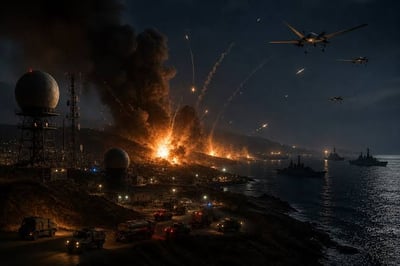
A fragile month of quiet across the Middle East came to an abrupt end overnight as military forces from the United States and Iran traded direct blows across key regional flashpoints. The sudden flare-up began when American fighter jets struck strategic Iranian rocket launchers stationed near the mouth of the Persian Gulf. Within hours, air raid sirens wailed across the desert skies of Jordan as Iran fired a retaliatory salvo of ballistic missiles and explosive drones at air bases housing American military personnel. The overnight exchange has reignited fears of a broader confrontation in one of the most economically sensitive maritime passages in the world, sending tremors through global energy markets and putting regional air defenses on high alert.
The renewed combat operations represent the first direct American strike on Iranian soil in over four weeks. Defense officials in Washington confirmed that the targeted strikes specifically focused on two launch systems belonging to the Islamic Revolutionary Guard Corps on Larak Island. The small Iranian island sits directly in the narrow choke point of the Strait of Hormuz, an essential trade artery through which nearly one-fifth of the entire global supply of crude oil and liquefied natural gas normally passes. According to military spokespersons from United States Central Command, surveillance units had detected Iranian forces actively preparing the launchers to fire rockets loaded with naval mines directly into international commercial shipping lanes.
The military operation on Larak Island unfolded on Sunday night, coming shortly after American naval units had spent days sweeping and clearing sea mines from primary international transport channels. Defense officials stated that the preemptive strike was necessary to protect the free transit of global commerce and prevent civilian cargo ships from facing sudden underwater explosive traps. However, reports emerging from Iranian state media presented a starkly different and painful picture on the ground. State television and local news agencies confirmed the explosions across Larak Island, stating that the attack caused casualties, with several military personnel and local civilians killed or wounded during the bombardment. Iranian officials condemned the operation as a fatal miscalculation by Washington, immediately promising a firm and decisive military punishment.
Tehran acted swiftly on its warning by launching an immediate counteroffensive early Monday morning. The aerospace division of the Islamic Revolutionary Guard Corps announced that it had fired a coordinated barrage of heavy ballistic missiles and long-range drones aimed directly at the King Hussein Air Base and the Muwaffaq Salti Air Base in Jordan. Both installations have long hosted American military personnel, surveillance equipment, and fighter aircraft. Sirens echoed across Jordanian towns as air defense interceptors raced into the sky. Jordanian military officials later confirmed that their active defense networks engaged the aerial threat directly, successfully shooting down eight incoming ballistic missiles before they could strike critical infrastructure or inflict severe casualties.
The rapid escalation has deeply unsettled international commercial shipping operators who have spent months navigating extreme hazards across the Persian Gulf. The Strait of Hormuz, which separates the rocky coastlines of Iran and Oman, is so narrow that commercial supertankers must pass within easy reach of coastal missile batteries and drone swarms. Traffic through this vital corridor has already slowed to a fraction of its normal volume, with international cargo companies redirecting vessels around the southern tip of Africa at immense financial cost. Following the strikes on Larak Island and the missile launches over Jordan, energy traders reacted instantly, pushing global crude prices up by nearly two percent in early morning trading as markets weighed the growing danger of prolonged waterway closures.
This latest exchange of heavy firepower highlights a dramatic shift in tactical realities. In recent weeks, American policymakers had indicated a strategic pivot away from intensive bombing campaigns, choosing instead to focus on severe economic sanctions and international trade restrictions designed to squeeze Iranian financial networks. Yet, the persistent presence of naval mines and coastal launch batteries demonstrates how difficult it is to replace deterrence on the water with economic pressure alone. Despite suffering heavy infrastructure losses and significant damage to conventional naval fleets over months of regional friction, Iranian forces retain thousands of mobile rockets, drones, and asymmetric sea mines capable of creating immediate disruptions.
On the streets of regional capitals, ordinary citizens are watching the confrontation with deep anxiety. From coastal fishing communities near the Strait of Hormuz to civilian neighborhoods across Jordan, families are caught in the uncertainty of a conflict that can erupt into explosive exchanges without warning. While military leaders and political strategists issue warnings from secure headquarters, it is local workers, maritime sailors, and nearby residents who face the daily terror of falling debris, shattered buildings, and economic paralysis. For hundreds of commercial ship crews currently anchored in open waters, every voyage through the gulf represents a life-threatening risk.
The confrontation also creates a complex diplomatic dilemma for neighboring Middle Eastern governments. Countries across the Arabian Peninsula have consistently called for restraint and backchannel negotiations, fearing that a full-scale regional conflict would devastate tourism, cross-border trade, and vital desalination plants. Jordan, which finds itself positioned geographically between competing regional powers, has had to rely heavily on its air defense systems to protect its sovereign airspace from becoming a routine missile corridor. Regional leaders are urgently engaging in diplomatic conversations behind closed doors to prevent the conflict from spiraling beyond the current tit-for-tat exchanges.
Security analysts caution that the cycle of retaliatory military actions is becoming harder to break. When one side launches an operation to remove a perceived tactical threat, the other feels compelled to respond forcefully to preserve its deterrence posture. With formal diplomatic negotiations between Washington and Tehran largely frozen, the risk of a miscalculation or an unintended direct hit on high-value military assets remains dangerously elevated. Every rocket fired into a shipping channel and every missile intercepted over a desert base brings the wider region closer to an unmanageable crisis.
As military forces across the Persian Gulf remain on maximum readiness, the international community faces an urgent challenge to restore stability to global transit routes. Commercial trade cannot function effectively under the constant threat of aerial bombardment and naval mining, nor can regional civilian populations endure unending cycles of air raids and missile alarms. The events unfolding between Larak Island and Jordan serve as a powerful reminder that without meaningful diplomatic engagement, local military strikes will continue to carry severe global consequences for economic stability, maritime safety, and human lives.