
Singapore installs 227 concrete blocks in sea to build planet's largest automated port at Tuas
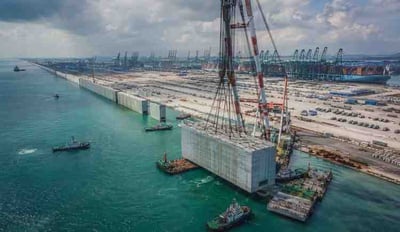
In a massive feat of maritime engineering along its western coast, Singapore is advancing construction on what will become the planet’s largest fully automated container terminal. To reclaim land from the sea for Phase 2 of the ambitious Tuas Port development, engineers are installing 227 giant hollow concrete structures known as caissons on the seabed. Each individual block measures nearly 10 stories high, spans over 130 feet in length, and weighs up to 15000 tons. Manufactured on-site and transported by floating docks, these monumental structures are carefully positioned by tugboats onto prepared rock beds before being filled with ballast material and compacted to withstand powerful ocean currents.
Together, the 227 caissons form a continuous 5.7-mile seawall that acts as a protective containment barrier for massive land reclamation. Phase 2 alone is designed to reclaim roughly 956 acres of land and add 21 million twenty-foot equivalent units of annual handling capacity. By March 2026, reclamation work for Phase 2 was nearly 80 percent complete, allowing terminal infrastructure and berth construction to rapidly take shape behind the newly formed maritime wall. Once all 4 phases of the Tuas megaport are fully realized in the 2040s, the complex will feature 66 berths across 16.2 miles of quay, capable of processing up to 65 million containers annually.
Beyond its sheer scale, Tuas Port represents a complete revolution in digital maritime logistics and supply chain automation. The entire facility operates as a synchronized digital network, utilizing driverless automated guided vehicles to move containers between wharves and storage yards. Automated electric cranes stack containers in the yard while operators manage complex ship-to-shore equipment remotely from a centralized control hub over a high-speed private 5G network. By removing manual bottlenecks, replacing paper documentation with digital clearances, and running autonomous operations, Singapore aims to cut turnaround times and significantly boost operational efficiency.
While the engineering milestone positions Singapore to maintain its status as a global shipping powerhouse, the project also highlights complex balance tests. Building a massive artificial coastline requires extensive seabed dredging, soil treatment, and heavy concrete usage, which inevitably impacts local marine ecosystems during construction. Project planners argue that long-term environmental benefits will outweigh initial construction impacts through electrified port vehicles, reduced vessel idling times, and lower day-to-day operational emissions. However, the true sustainability of the megaport will depend on whether its operational energy efficiency can offset the heavy carbon footprint of its massive reclamation process.
In short, the installation of these 227 massive caissons demonstrates how innovative infrastructure can push the boundaries of land constraints to secure economic competitiveness. By combining heavy civil engineering with cutting-edge artificial intelligence and zero-emission vehicle fleets, Singapore is establishing a new benchmark for global maritime trade hubs. As global trade demands expand, Tuas Port stands as a testament to strategic long-term planning and technological leadership on the ocean frontier.