
SpaceX Starship Achieves Softest Indian Ocean Splashdown During Flight 13 Test
On 24 July 2026, aerospace company SpaceX achieved a major milestone in rocket reusability with the completion of its 13th integrated Starship test flight. Lifting off at 5:51 PM local time from the Starbase launch facility in Boca Chica, Texas, the towering 40-story vehicle rose into the evening sky powered by 33 Raptor engines on the Super Heavy V3 booster. Minutes into the flight, the spacecraft successfully executed a hot-staging separation mechanism, allowing the Starship upper stage vehicle to ignite its engines and proceed on a suborbital trajectory toward space while the booster maneuvered back toward Earth.
During its coast phase through orbit, the Starship upper stage executed multiple technical demonstrations vital for future deep space exploration. For the first time, the ship successfully deployed 20 next-generation Starlink Version 3 satellites into space, with several onboard cameras capturing real-time high-definition video of the deployment process. Following payload release, SpaceX engineers performed a 14-second in-space reignition test of a single Raptor engine, proving critical maneuvering capabilities required for orbital insertion and deorbit burns on future operational missions.
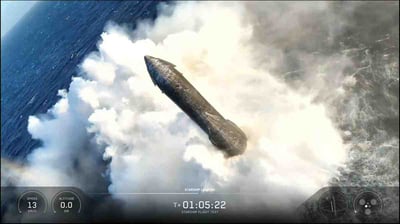
The flight concluded with a dramatic atmospheric reentry as Starship descended through intense friction-induced plasma over the Indian Ocean west of Australia. Demonstrating thermal protection upgrades across its heat shield, the spacecraft initiated a precise three-engine flip maneuver before executing a soft vertical descent onto the ocean surface. Floating upright briefly before tipping over to rest on the water, the vehicle remained intact and continued transmitting telemetry data back to ground controllers, marking what SpaceX commentators described as the softest splashdown ever achieved by the program.
The successful splashdown represents a major step forward in establishing rapid rocket reusability for interplanetary travel and heavy orbital logistics. While the Super Heavy booster encountered partial engine relight issues during its final landing burn in the Gulf of Mexico, the upper stage performance yielded invaluable real-world data on heat shield durability, payload deployment mechanisms, and in-space engine reignition. Gathering high-fidelity telemetry from intact ocean splashdowns brings SpaceX closer to its ultimate goal of capturing and rapidly reusing both stages for future lunar Artemis missions and long-term space exploration.