
Supreme Court Directs Allahabad High Court To Prioritise Azam Khan ED Arrest Challenge And Hear Case On November 16
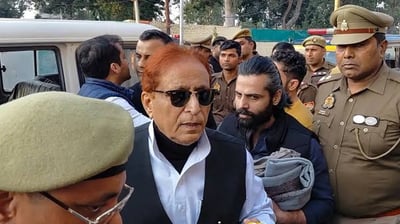
The Supreme Court of India has directed the Allahabad High Court to give early attention to an urgent petition filed by senior Samajwadi Party politician Azam Khan, scheduling the matter for hearing on November 16. The veteran political leader had directly approached the highest court of the country after being taken into custody by central financial investigators moments after walking out of prison on bail. While the top court declined to hear the case on its own merit at this stage, it recognized the urgency of the matter and asked the regional high court to take up his arguments without unnecessary delay.
The legal dispute centers on the dramatic detention of the ten time state lawmaker outside the gates of Rampur district jail. Azam Khan and his son Abdullah Azam Khan had just completed their legal release paperwork after securing bail in a long running case concerning dual identity cards. However, as the senior leader prepared to step through the prison gates into freedom, officials from the Enforcement Directorate were waiting outside to take him into immediate custody under federal money laundering laws. The sudden action by the federal agency shocked his legal team and supporters, who viewed the rearrest as a deliberate attempt to keep him behind bars.
In his comprehensive petition submitted before the top court, the seventy eight year old leader voiced serious complaints about the treatment he has faced over recent years. He alleged that he has become the target of a continuous series of politically motivated legal cases designed to break his spirit and end his public career. His legal representatives pointed out a disturbing and predictable pattern in his treatment. Whenever the politician manages to secure bail or finish a jail sentence in one legal battle, state authorities or federal investigation agencies suddenly bring forward a new investigation or revive an old inquiry to ensure he is never allowed to return home.
His lawyers brought to light that the politician has been named as an accused in nearly ninety five separate police complaints and official cases over the past decade. Out of these numerous legal challenges, he has earned complete acquittals in six matters, while three other investigations were officially dropped after police failed to find any evidence against him. In cases where trial courts handed down sentences, his legal team has either secured stays from higher appellate courts or he has already completed the required time in custody. The remaining bulk of around eighty cases continues to crawl through various stages of trial, keeping him trapped in endless courtroom procedures.
During arguments before the two judge bench of the Supreme Court, senior advocates representing the politician argued that his fundamental human rights were violated during the latest detention. They pointed out that central officers arrested him using an old case file that had been sitting idle for seven years without proper movement. His legal counsel highlighted that the central agency failed to hand over a formal written arrest memo or provide clear legal grounds at the moment of taking him away, which goes against established constitutional protections granted to every Indian citizen facing arrest.
On the other side, government prosecutors and central agency lawyers opposed his direct plea before the Supreme Court, arguing that proper legal hierarchies must be followed by every citizen. The state side noted that the politician has an extensive history of criminal complaints and previous convictions handed down by regional magistrate and sessions courts. They insisted that central agencies possess the legal duty to investigate financial wrongdoing and money movement, regardless of the age or political status of the accused person. State lawyers argued that regular bail procedures should be examined by the local high court that has direct jurisdiction over Uttar Pradesh matters.
Taking both arguments into consideration, the bench led by the Chief Justice explained that high courts are fully equipped to examine whether an arrest made by an investigation agency follows proper statutory guidelines. Rather than keeping the petition pending in New Delhi, the judges decided to transfer the entire bundle of legal papers directly to the Allahabad High Court. To make sure that the plea does not get lost in busy court schedules, the bench issued a clear judicial direction asking the High Court registry to place the case before an appropriate bench on November 16.
The legal outcome is being watched with deep interest by political circles across Uttar Pradesh, where Azam Khan remains one of the most prominent regional leaders. For decades, the veteran leader held powerful cabinet positions in the state government and represented his home constituency in both the national parliament and the state legislative assembly. His continuous stay in prison and repeated detentions have sparked constant heated debates between the ruling party and opposition groups over the use of central investigative agencies against political rivals.
For Azam Khan and his family, the upcoming hearing on November 16 represents another crucial legal battle for personal liberty. His supporters hope that the High Court will examine the circumstances of his rearrest outside the jail gate and grant relief so that he can receive proper medical care and rest at home. As the legal machinery prepares for the arguments next week, the development serves as a sharp reminder of the fine balance Indian courts must maintain between investigating financial crimes and safeguarding the personal liberty of citizens against procedural unfairness.