
Democrats Dominate US Midterm Elections In Districts With High Indian American Population By Winning 84 Seats
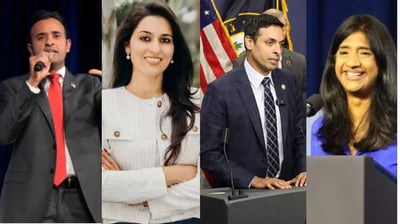
The Democratic Party has achieved a massive political victory across the United States by winning eighty four out of the top one hundred congressional seats that hold the largest populations of Indian American voters. A detailed review of voting data across all four hundred and thirty five seats in the United States House of Representatives shows that areas with strong South Asian communities voted decisively in favor of Democratic candidates. These top hundred areas are home to more than half of the entire Indian American population living in the country. The overwhelming preference shown by these voters provided a strong push to the party, proving that the diaspora continues to serve as an influential and solid voting group in American national politics.
The strongest display of support for the party appeared on the West Coast, especially across the state of California. Out of the twenty voting districts in California that appear on the national list of top areas with Indian residents, the Democratic Party captured nineteen victories. The most prominent among these was the seventeenth congressional district, which holds the highest concentration of Indian Americans anywhere in the United States. In that key district, popular Indian American lawmaker Ro Khanna secured a decisive win, earning his sixth straight term in the national legislature. His victory highlighted the deep connection between local families, technology workers, and the policies championed by the party in the Silicon Valley region.
The sweeping success of the party was not confined to the western part of the country. In several major states along the East Coast and across the Midwest, Democratic candidates made a clean sweep of every single district that had significant Indian American populations. In New York, Illinois, New Jersey, and Pennsylvania, every top ranked district on the community population chart went straight into the Democratic column. The momentum of this voting wave was strong enough to dislodge established Republican figures from their long held seats. Two prominent Republican members of the House India Caucus, Brian Fitzpatrick in Pennsylvania and Tom Kean Jr in New Jersey, lost their reelection battles as voters turned out in large numbers to support Democratic challengers.
While Democrats celebrated historic wins in northern and coastal states, the southern battleground of Texas presented a very different picture. Even as the national election outcome cost the Republican Party control of the legislature, Republican candidates managed to hold their ground across several areas in Texas. The state contains thirteen congressional districts with large Indian American communities, and Republicans won nine of those races. Lawmakers such as Beth Van Duyne secured victory despite facing heavy public criticism for associating with commentators who raised doubts about foreign worker visas used by Indian professionals. Another Republican victory took place in the twenty second district near Houston, where Trever Nehls won in an area with forty five thousand Indian residents.
The final voting numbers closely matched what major research organizations had observed before election day. A major survey conducted by the Carnegie Endowment in partnership with YouGov found that sixty two percent of Indian American citizens planned to vote for Democratic candidates running for the House of Representatives, while only nineteen percent expressed support for Republicans. In elections for the United States Senate, the preference was equally clear, with sixty three percent backing Democrats compared to twenty one percent choosing the other side. These numbers confirmed that the political loyalty of the community has remained remarkably steady over several national election cycles.
Detailed public opinion studies help explain the reasons behind this strong political leaning. A nationwide study carried out between late 2025 and early 2026 showed that seventy one percent of Indian American adults disapproved of the job performance of former leader Donald Trump, while only twenty nine percent expressed approval. When asked about their daily worries, community members repeatedly pointed to rising household expenses and high grocery prices as their top problems. Job stability, the general health of the national economy, affordable medical care, and fair immigration policies also featured at the top of their concerns. Families felt that the policies presented by the Democratic leadership offered better protection for their household budgets and workplace stability.
Another major reason for the political shift was growing anxiety over public treatment and social safety. In recent surveys, nearly half of Indian Americans reported that they frequently saw hostile and hateful remarks targeting their community on internet platforms. Almost one third of community members admitted that seeing continuous online hostility caused them to pull back from sharing their political thoughts on social media. Furthermore, sharp public comments made by certain political candidates, including insulting remarks about Hindu cultural symbols and temples in Texas, created deep hurt among community elders. These unfortunate incidents convinced many families that they needed to use their voting cards to support leaders who promote social harmony and respect for diverse cultural backgrounds.
The election outcome also brought renewed energy to the group of Indian American lawmakers serving in the United States Congress, popularly known in political circles as the Samosa Caucus. Along with experienced representatives returning to Washington, the group saw strong performances by candidates in tight races, including doctor turned politician Amish Shah in Arizona. In Virginia, lawmaker Suhas Subramanyam won a convincing victory by securing more than sixty one percent of the total votes in his constituency. The growing presence of these representatives ensures that the cultural values, economic concerns, and civil rights of South Asian families will receive continuous attention inside the halls of the national capitol.
The dramatic sweep across eighty four districts carries a major lesson for political strategists in both major American parties. For decades, political commentators viewed the Indian American community mainly as generous financial donors rather than a decisive voting bloc. However, rapid population growth across suburban neighborhoods in states like Georgia, Pennsylvania, and Texas has turned these families into kingmakers in close contests. When thousands of educated professionals, business owners, and young students step into polling booths together, they possess the numbers needed to flip battleground seats and change the balance of power in Washington.
As the newly elected representatives prepare to take their oaths of office, the results from the midterm elections leave no doubt about the political direction of the diaspora. By voting heavily for candidates who defend civil dignity, equal opportunities, and fair immigration systems, Indian American citizens have sent an unmistakable message to the nation. Their active civic participation proves that immigrant communities are not just passive observers of American democracy, but active shapers of its legislative future.