
Gyanesh Kumar Vote Chor To Form Govt Of BJP? Rahul Gandhi Warns Election Chief Will Go To Jail Over Stolen Mandate Claims
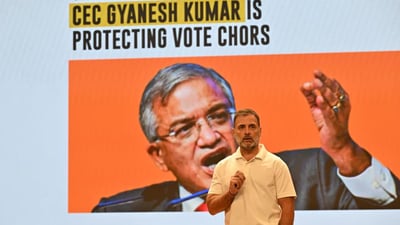
Leader of Opposition Rahul Gandhi addressed a massive gathering of opposition supporters in the national capital, issuing a direct and sharp warning to the top leadership of the Election Commission. Speaking from a high wooden platform before a sea of party workers waving multi-colored flags, the senior leader declared that Chief Election Commissioner Gyanesh Kumar would one day face jail time for what he called treason against Indian democracy. The fiery speech served as the high point of a united opposition rally organized under the banner of protecting the vote and defending the national constitution. The crowd answered his statements with loud cheers and rhythmic clapping that echoed across the historic grounds.
The massive gathering brought together prominent leaders from across the national opposition alliance. Rahul Gandhi used the public platform to challenge the fundamental legitimacy of the ruling government, directly calling the 2024 general election result an illegal outcome. He claimed that the election was not won through honest public support but was taken through deliberate manipulation of voter rolls. Standing before thousands of listeners who had traveled from nearby states, he stated that systematic changes to voter lists had unfairly taken away the basic voting power of millions of ordinary citizens.
In his address, the Congress leader explained what he described as massive vote stealing in plain and everyday terms. He explained to the crowd that this was not like a common pickpocket stealing goods from a roadside grocery shop, but a much bigger crime that quietly robs the fundamental voice of a sovereign population. Gandhi alleged that around fifteen percent of genuine registered voters across different parts of the nation saw their names erased from official lists through recent voter list revision exercises. Because so many citizens were quietly dropped from the lists, he argued that the entire government formed after the last election has no true moral right to rule.
The speech did not stop at criticizing the head of the election body. Turning his focus directly toward the top political leadership of the country, Gandhi warned Prime Minister Narendra Modi and Home Minister Amit Shah that they would not be able to escape future accountability. He stated clearly that legal action would be pursued against everyone involved in altering voter rolls once the political landscape shifts. Pointing outward toward the crowd, he said that leaders who misuse administrative offices cannot run away from their actions forever, promising his supporters that the truth behind missing voter names would be investigated thoroughly.
Moving beyond political anger, the Leader of Opposition also shared his broader thoughts on what the country should look like after the current government tenure. He spoke about creating a society based on love, mutual respect, and social peace rather than constant hatred and public division. He told the gathering that his political struggle is not born out of personal anger toward any specific minister, but out of a deep duty to protect the voice of everyday citizens. In his words, standing up for the basic rights of farmers, factory laborers, young students, and poor women is the most sacred duty anyone can serve.
The ruling Bharatiya Janata Party responded immediately with sharp criticism against Rahul Gandhi and his alliance partners. Government spokespersons strongly dismissed the speech during public addresses, calling the opposition rally a desperate political drama designed to mislead the country. Ruling party leaders pointed out the timing chosen for the demonstration and accused the opposition of trying to cover up repeated electoral defeats. Government representatives maintained that the election results reflected the genuine will of hundreds of millions of voters who went to polling booths to cast their ballots freely.
The Election Commission has also repeatedly dismissed the claims of bias and voter list manipulation as completely false and irresponsible. Official representatives explained that the regular cleaning of electoral rolls is an essential administrative duty done openly with all political parties present at local levels. The commission clarified that entries are only removed after careful ground checks to eliminate names of deceased persons, people who have permanently shifted to new cities, or duplicate registrations. Top election officials had previously challenged opposition figures to bring forward verified proof of deliberate voter deletion rather than making broad political accusations in public rallies.
Thousands of ordinary supporters who stood through the long speeches had their own personal reasons for attending the central Delhi rally. Many young college students holding paper posters spoke about their fears that local voter identification cards might get rejected on voting day without proper notice. Small farmers and daily wage workers who traveled long distances on night trains said they wanted to hear leaders talk directly about jobs, school education, and rising food costs. The large crowd showed that questions regarding how elections are organized and monitored have become an active talking point among regular working-class families.
Political analysts tracking national events noted that directly naming a constitutional authority like the Chief Election Commissioner and threatening him with prison marks a serious rise in political tension. In a healthy parliamentary system, official institutions must maintain broad public trust to function smoothly. When the main opposition alliance openly questions the fairness of the election referee, it creates a deep division in how citizens view future democratic outcomes. Experts warn that continuous friction between major political parties and election bodies could weaken long-standing traditions of peaceful power transfer.
As the rally drew to a close, opposition leaders signed a joint declaration promising to take their street protests across various state capitals and small towns. Protesters packed up their banners, collected their belongings, and slowly moved toward local railway stations and bus stops. The bold words spoken on the stage left behind strong political ripples that will clearly continue to shape public debates in parliament and local communities for many months to come.