
Indian Origin Five Year Old Arjun Prajapati Enters Mensa And Intertel With 141 IQ After Exploring Over 3000 Books
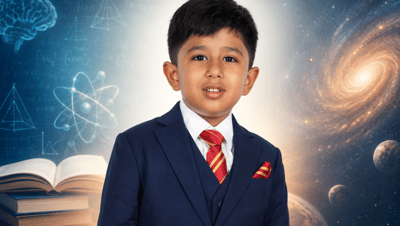
A young child from a family of Indian background is surprising scholars and educators across the globe with his extraordinary learning journey. Five year old Arjun Prajapati has already turned the pages of more than three thousand books, exploring complex topics that usually challenge senior university students. While most children his age spend their days watching cartoons or playing with toys, Arjun spends his time asking thoughtful questions about outer space, numbers, and the human body. His natural hunger for knowledge has allowed him to earn an exceptional intelligence score of 141, placing him among the most gifted young minds in the world.
Arjun began his journey into reading when he was just eighteen months old. His mother Mahitha and father Dr Prajapati noticed his sharp attention right after he was born. The infant was constantly looking around and observing everything in the room. As he grew into a toddler, colorful picture books quickly became his favorite items in the house. Instead of throwing things or looking for mobile screens, he sat quietly to study alphabet shapes and listening to words read aloud by his parents. In a matter of months, recognizing letters transformed into reading complete sentences, and simple storybooks were soon replaced by science volumes and nature encyclopedias.
When Arjun turned four, licensed psychologists conducted formal intelligence evaluations using standard assessment tests to measure his cognitive abilities. The final score revealed a full scale intelligence score of 141, placing him in the top ninety-nine point seven percentile of all test takers worldwide. This result means that Arjun scored higher than almost all children in his age bracket across the globe. His non-verbal logic was measured even higher at 149, while his working memory and fluid reasoning reached remarkable levels of 146 and 144. These outstanding scores granted the young boy direct membership into two world famous high intelligence groups, Mensa and Intertel, which are reserved exclusively for individuals scoring in the highest percentiles of human intellect.
Unlike many households where digital devices take center stage, the Prajapati home runs on paper books and personal conversations. His parents made a conscious decision to avoid handing him tablets or mobile phones whenever he felt bored. They believed that when a child experiences boredom without a glowing screen to distract them, their brain naturally searches for real world creativity and answers. The family home holds stacks of educational volumes, and their car regularly carries eight to ten books so that the child never feels empty-handed during long road journeys. He frequently carries a book to the breakfast table, takes one along on family vacations, and even tucks a book under his pillow before falling asleep at night.
The young boy has a deep interest in human biology and medical science that astonishes seasoned doctors. While reading about the human body, Arjun learned how blood circulates, how the heart pumps, and how the immune system defends against seasonal infections. When his mother once reminded him to wash his hands properly, he smiled and explained that his white blood cells were actively guarding him against germs. In another family conversation about how human life begins, he happily told his mother that without her eggs, neither he nor his sister would be present in this world. He has also explored complex ideas about human genetics, pointing out chromosomes to his father and reading about how microscopic cells battle illnesses inside living beings.
Space and mathematics form another massive area of excitement for the five year old boy. He often sits with paper and pen to ask his father what would happen if someone subtracted infinity from infinity. Rather than memorizing simple multiplication tables, he wants to understand why mathematical equations behave the way they do. He reads about giant black holes, distant star systems, dinosaurs from prehistoric eras, and the layers of soil deep beneath the Earth. Once, he curiously asked what would happen if a gigantic cutting tool sliced our planet straight through to the molten core, showing an imagination that connects physics with physical geography.
Even routine family drives turn into active educational expeditions for the bright child. Arjun pays sharp attention to highway signs, road exits, and city route markers while looking out the car window. He often tracks the route on the digital car map, observing water bodies, rivers, and terrain features as the family moves from one place to another. To him, every road sign and geographic turn is a live puzzle waiting to be solved, turning daily travel into a practical lesson about topography and directions.
Despite the widespread attention surrounding his remarkable test scores, his parents are firmly determined to keep his everyday life grounded in happiness and warmth. They believe that a high intelligence quotient must never turn into a heavy burden for a growing boy. His parents avoid rigid timetables, private coaching classes, or forced study hours. Instead, they let his own curiosity lead the day. If he wants to spend three hours inside a public library browsing book stacks, they sit beside him. If he wants to run around the neighborhood park or play with blocks, he is encouraged to play freely like any other five year old boy.
His family also follows a supportive rule when it comes to parenting and handling difficult questions. Whenever Arjun asks an unusual scientific question that his parents cannot answer on the spot, they never dismiss him or say they do not know. Instead, they tell him that it is a brilliant question and invite him to sit together and search for the answer through trustworthy books or encyclopedias. This open approach teaches the child that not having an immediate answer is natural, and that finding the truth through reading is the true heart of scientific discovery.
The story of Arjun Prajapati has drawn admiration from international academic centers and public institutions. The young boy has visited world famous educational institutions including Harvard University and the Massachusetts Institute of Technology, where faculty members were charmed by his polite manners and sharp inquiries. Furthermore, the Legislative Assembly of Ontario invited him to receive special recognition at Queen Park on October 29, 2026, honoring his dedication to reading and knowledge at such a young age.
His parents emphasize that their primary wish is not for their son to become a celebrated public figure or achieve record titles, but to grow into a compassionate, balanced, and joyful human being. They hope his story serves as a gentle reminder to parents everywhere that nurturing a love for physical books, encouraging endless questions, and offering patient companionship can open limitless horizons for any curious child.