
Iran Sees No Threat From Saudi Pakistan Turkey Security Pact as Tehran Claims Shift Away From United States Security Promises
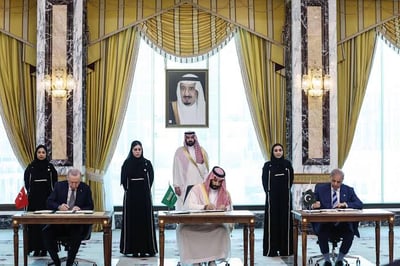
The diplomatic landscape of the Middle East experienced a significant realignment following the signing of a landmark mutual defense agreement between Saudi Arabia, Pakistan, and Turkey. The trilateral framework, established during a joint defense summit in Makkah featuring Saudi Crown Prince Mohammed bin Salman, Turkish President Recep Tayyip Erdogan, and Pakistani Prime Minister Shehbaz Sharif, introduced a mutual defense clause specifying that an armed attack against any single member will be treated as an attack on all three signatory nations. While international observers initially viewed the strategic arrangement as a potential counterweight against Iranian influence, official representatives in Tehran publicly downplayed any immediate security anxieties. Iranian Foreign Ministry spokesperson Esmaeil Baghaei addressed the development during a press conference, stating that Tehran sees no reason to worry that the newly formed security agreement is directed against Iran. Baghaei emphasized that Iran shares deep religious, historical, and civilisational connections with all three participant nations, reinforcing the view that regional defense initiatives do not necessarily pose a threat to neighbouring states.
Instead of treating the defense alliance as a direct threat, Iranian foreign policy representatives framed the pact as a major symbolic turning point in regional perceptions regarding external powers, particularly the United States. Iranian officials argued that the agreement among Riyadh, Ankara, and Islamabad demonstrates that nations across the region are increasingly realizing that security cannot be treated as a commercial commodity imported from external actors. According to statements from the Iranian Foreign Ministry, regional leadership has gradually recognized that long standing claims of protection provided by Washington are no longer reliable guarantees during times of crisis. Tehran interpreted the decision by three major Muslim majority states to construct an independent security structure as evidence that regional capitals are shifting their strategic calculations toward self reliance and local diplomatic mechanisms. Rather than depending on Western military umbrella arrangements, the signatory powers are attempting to establish their own collective deterrence framework grounded in domestic capabilities and shared strategic goals.
The individual strengths brought by each participant render the trilateral alliance a formidable military and geopolitical grouping within the region. Turkey contributes the second largest armed forces within the NATO alliance alongside a rapidly expanding domestic defense manufacturing industry. Saudi Arabia provides immense financial resources as one of the top global energy producers and holds significant diplomatic influence as the custodian of Islam's holiest sites. Meanwhile, Pakistan contributes a battle tested military apparatus and stands as the only nuclear armed state within the Muslim world. Together, these three nations combine distinct military assets, strategic depth, and economic weight into a unified framework aimed at deterring external aggression and maintaining regional balance. Officials involved in the treaty negotiations described the arrangement as purely defensive in nature, emphasizing that the pact remains open to participation by other regional partners and does not seek to dismantle pre existing bilateral or multilateral security arrangements.
Despite the official diplomatic composure displayed by the Iranian Foreign Ministry, reactions within Iranian political circles revealed underlying skepticism regarding the longevity and practical effectiveness of the new agreement. High ranking Iranian lawmakers expressed doubt about whether paper guarantees between regional capitals could truly guarantee lasting security without addressing fundamental political dynamics. Some Iranian parliamentary representatives pointed out that decades of heavy reliance on Western military backing had failed to insulate regional nations from recurring security challenges, arguing that signing treaties with partner states would similarly fall short unless accompanied by broader policy shifts. Iranian commentators stressed that lasting peace across the Middle East requires inclusive security architecture involving all regional actors rather than selective security pacts. Furthermore, Iranian officials highlighted that any defensive initiative must accurately identify real threats to the region, particularly referencing actions taken by Israel and foreign interventionists, rather than creating artificial divisions among neighboring nations.
The formal introduction of the Makkah agreement comes during an era of heightened geopolitical instability that has disrupted vital international trade routes and elevated military alerts across West Asia. Neighboring powers, including India, confirmed that they are monitoring the strategic implications of the pact closely, recognizing that a unified military defense clause among three major powers could reshape the regional security balance. To manage potential friction and prevent miscalculations, diplomatic channels between Tehran and Islamabad were activated shortly after the announcement. Pakistani foreign policy officials held direct phone discussions with Iranian leadership to explain the core objectives of the defense treaty, reiterating that the alliance is designed to foster collective stability and is not targeted at any neighboring nation. As regional governments navigate this evolving security environment, the emergence of the Saudi, Pakistani, and Turkish defense bloc underscores a broader global trend where middle powers actively construct independent alliances to navigate an increasingly uncertain geopolitical order.