
Karnataka Protesters Carry Longest List Of Deleted Voters In Delhi Opposition Rally Demanding Election Chief Resignation
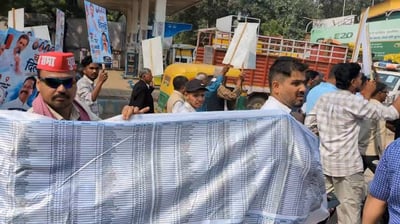
The streets of New Delhi witnessed a striking sight as a large group of citizens and political workers from Karnataka walked into the national capital holding an enormous paper roll. As thousands of people joined the opposition march toward Ramlila Maidan, this delegation from the southern state drew everyone attention with what they called the longest list of deleted voters. Unrolling a giant white sheet printed with endless rows of names, addresses, and registration numbers, the demonstrators walked steadily through central avenues. Their goal was to show the whole country real evidence of citizens who lost their voting rights during recent administrative revisions carried out by election officials.
The peaceful procession began from the busy junction connecting Minto Road and Connaught Place. Top opposition leaders, including Rahul Gandhi and other key parliamentarians, walked alongside common citizens, heading toward the iconic open ground. While national leaders spoke about constitutional rights and political freedom, the Karnataka group brought the human side of the problem directly to the road. People holding the heavy paper roll explained that each line on the paper represents a real human being living in a village or town whose name was quietly removed from official government registers without their knowledge.
The controversy in Karnataka centers on a special exercise carried out by authorities to update and verify electoral rolls. According to protest organizers, election workers deleted thousands of names of poor and working class families under the claim of removing duplicate or dead voter records. When local activists visited neighborhood polling areas to check the lists, they found that countless living people had been marked as absent or shifted. This unexpected loss of voting identity led several citizen forums, youth groups, and regional party units to band together, collect the deleted entries onto computer sheets, and print them out onto a single giant scroll to take all the way to the national capital.
For many Karnataka delegates, traveling to New Delhi was a difficult physical journey that required deep dedication. They spent more than thirty hours traveling on crowded trains across several states just to reach the demonstration site in time. Carrying heavy rolls of printed paper, flags, and water bottles, these workers wanted to make sure that the voices of southern families were heard inside the offices of central decision makers. One worker holding a corner of the banner noted that when poor daily wage earners lose their voter cards, they also lose their ability to question local politicians about water pipelines, ration shops, and village schools.
The atmosphere around the march remained energetic as the Karnataka group chanted slogans in both Kannada and Hindi. Passersby, auto drivers, and office workers stopped along the footpaths to watch the long banner move slowly through the street. Many curious locals walked up to the banner to read the printed details with their own eyes. The printed list stretched across dozens of meters, requiring ten to fifteen people walking in a straight line just to hold it up off the dusty ground. This unusual visual display turned a dry debate about numbers and voter registration forms into an understandable human story that everyone could see and grasp immediately.
Inside the grounds of Ramlila Maidan, opposition alliance leaders addressed the massive gathering from a grand stage. Speakers pointed directly to the giant list from Karnataka as clear proof of systemic problems in the electoral machinery. Leaders reiterated their strong demand for the immediate resignation of Chief Election Commissioner Gyanesh Kumar, accusing the election body of failing to act as an independent and fair umpire. They claimed that the widespread deletion of voters in opposition strongholds helps the ruling party win elections through unfair administrative means rather than genuine democratic support.
On the other hand, the Election Commission and spokespersons for the ruling party strongly rejected all accusations of foul play. Official authorities maintained that the voter list revision is a routine, transparent legal process designed only to clean up the voter database. They clarified that notices are sent before any record is removed and that every registered voter has the full right to submit an appeal to get their name restored. Ruling party leaders accused the opposition of creating fake drama with printed banners to mislead simple citizens and make excuses for their own political weaknesses before upcoming state elections.
Security across central New Delhi was put on high alert to handle the large influx of demonstrators. Delhi Police deployed thousands of personnel along the march route and put up iron barricades around sensitive government offices. Traffic police diverted buses and private cars onto alternate routes, which caused heavy traffic jams across several surrounding neighborhoods. Despite the tense situation and heavy security presence, the Karnataka marchers remained peaceful, continuing their walk alongside students, farmers, and factory workers from other states.
The visual of the giant deleted voter list from Karnataka highlighted the growing coordination among regional groups across the country. In previous years, protests about local voter deletions stayed within individual districts or state capitals. However, by bringing local documents directly to New Delhi, southern activists showed that they are determined to link state-level grievances with the broader national fight for constitutional democracy. The demonstration proved that modern technology allows local volunteers to track, print, and publicize administrative records in ways that were never possible in the past.
As the sun began to go down and the loud speeches at the venue concluded, the delegates from Karnataka carefully rolled up their long paper scroll to protect it from dust and mud. They gathered near regional transit hubs to begin their long return journey back to southern towns. While the leaders returned to television studios to argue their cases, the physical list of deleted names remained a powerful reminder of the ongoing struggle. For the common people who made the long journey, the fight to restore each stolen vote has only just begun.