
Prakriti Malla Beautiful Handwriting: Nepali Schoolgirl Stuns the World with Lettering That Looks Like Computer Font
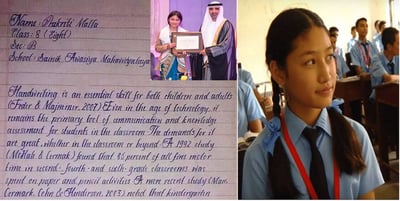
A schoolgirl from Nepal has captured the attention of millions of people around the world simply by using an ordinary pen and paper. Prakriti Malla, a young student living in Kathmandu, became a global internet sensation when a photograph of her school notebook went viral across social media platforms. Her letters were written with such balance, neatness, and precision that readers could hardly believe it was done by hand. At first glance, people thought the page had been printed directly from a computer using a stylish digital font. In an era where most people spend their days tapping on mobile screens and laptop keyboards, her rare skill reminded the world of the lost beauty of traditional penmanship.
The story began when a photograph of one of Prakriti's class assignments was shared online by someone who noticed her unique talent. The notebook page contained an essay on the importance of good handwriting. Ironically, the essay itself was the greatest proof of her message. Every single letter was formed with consistent curves, equal height, and perfect spacing between words. The alignment was straight, the margins were clean, and there was not a single scratch, smudge, or correction visible on the paper. Within a few hours, the image travelled across platforms such as Facebook, Twitter, and Reddit, gathering hundreds of thousands of likes, shares, and comments from admiring readers in different countries.
People on the internet could not stop talking about the sheer discipline behind the page. Many users joked that her handwriting looked neater than standard typing fonts like Times New Roman or Georgia. Others pointed out that her cursive strokes were so uniform that they looked like artwork created by a calligrapher. Educational groups, teachers, and student communities shared the photograph widely, encouraging young learners to take inspiration from her neatness. Her name quickly became a symbol of patience, practice, and traditional learning in a digital world.
Her remarkable discipline was not an overnight miracle. Prakriti was a student at the Sainik Awasiya Mahavidyalaya, a well-known school in Bhaktapur, Nepal, which is managed under the guidance of the Nepali Army. The school environment is famous for teaching discipline, order, and steady work habits. When journalists and visitors spoke to her family and teachers, they revealed that Prakriti had been working on her letters since her early childhood days. While many children rush through their homework to play or watch television, Prakriti took deep joy in drawing each alphabet carefully. She spent extra time practicing every afternoon, paying close attention to how each curve and line joined the next.
Her parents and teachers observed that she never treated writing as a chore. To her, holding a pen was an artistic exercise. She practiced the exact angle of her pen, the pressure she applied on the paper, and the distance between adjacent words. This patient daily routine gradually trained her hand and eyes to produce letters with remarkable uniformity. Her teachers noted that whether she was writing a short class test or a long project, her speed and perfection never dropped. Her notebook became an example displayed to other students in the school to encourage them to write legibly.
The massive reaction on the internet soon caught the attention of national leaders and educational authorities in Nepal. Officials from the government and cultural groups visited her to offer personal praise. The leadership of the Nepalese Armed Forces publicly felicitated her, expressing pride that a student from their institutional school had brought positive international attention to the nation. Senior officials remarked that her achievement sent an inspiring message across the world, demonstrating that simple human focus and hand skills can outshine digital screens.
Experts in handwriting analysis and calligraphy also weighed in on her viral notebook. Many educational researchers pointed out that writing by hand plays an essential role in brain development, memory retention, and motor coordination in children. When students write by hand rather than type, their brains engage more actively with the information. Handwriting specialists observed that Prakriti's writing showed rare spatial awareness, balance, and calm focus. Some commentators suggested that her handwriting style could even serve as a standard model for teaching handwriting to primary school students across South Asia.
Despite receiving overwhelming attention from newspapers, television channels, and online forums, Prakriti stayed humble and focused on her daily school studies. Her friends and classmates described her as a modest girl who took the sudden attention in stride. While millions of people across continents talked about her, she continued to sit in her usual classroom, writing her everyday lessons with the same care and joy she had shown before the world discovered her.
The story of Prakriti Malla remains a warm reminder for students, parents, and educators everywhere. It proves that in a fast-moving world dominated by computers, touchscreens, and automated tools, basic human craft still holds immense value. Her viral fame showed that excellence does not always demand fancy gadgets or complex technology; sometimes, it only requires an ordinary pen, a blank notebook, and the patience to get every single letter right.